
- 0
- 772 words
Newly discovered “black hole star” could solve mystery of strange red dots spotted in the early universe
Astronomers announced Wednesday they had discovered a new type of astronomical object called a “black hole star,” potentially solving a mystery involving strange red dots spotted in the early universe.
The object looks like a star the size of our solar system, but produces 100 billion times more energy than any star — a mighty blast of power closer to what is produced by a black hole.
The black hole star, which dates from 660 million years after the Big Bang, was spotted by a U.S.-led team of astronomers using the James Webb Space Telescope, according to a study published Wednesday in the journal Nature.
Since history’s most powerful telescope went online in 2022, it has been spotting many extremely bright cosmic objects dubbed “little red dots” in the early universe that have baffled scientists.
“What exactly these objects are has been one of the most debated topics of the JWST era,” lead study author Rohan Naidu of the University of Hawaii said in a statement.
The team had been trying to find clues for a different mystery: why JWST keeps finding bright galaxies in the universe’s infancy, when it was thought to have been too early for them to have become so huge.
But while looking through the images, they spotted a little red dot.
“Pure black hole star light”
“When we see something very red in the universe, we often assume that it is surrounded by dust, like soot or ash,” said Robert Simcoe, a study co-author from the Massachusetts Institute of Technology.
“The same way that the wildfire smoke from Canada recently made the sky in Boston look bright red, astronomical objects can also appear redder than their intrinsic color when you see them through a veil of dust,” he added.
However, when the team sifted through their data, they found that at certain wavelengths, the object’s light simply disappeared.
To their surprise, this suggested that it is not dust making this object appear red — it is hydrogen gas.
This explained the object’s color, but not how it could be pumping out so much energy.
“You can’t be powering this by nuclear fusion, which is the energy source that sits at the heart of all the stars,” Naidu explained.
Using modeling simulations, they determined the most likely scenario was that the object is powered by a central black hole surrounded by a cocoon of gas that makes it resemble a star.
The team named the object MoM-BH*-1. The BH and asterisk are for black hole star — and the number one suggests they believe there are more out there.
“Every little red dot is consistent with being a black hole star,” Naidu said.
“What is special about MoM-BH*-1 is, the black hole star is essentially completely outshining its surrounding host galaxy, such that we’re seeing pure black hole star light.”
Webb reveals dust and water surviving near Milky Way’s central black hole
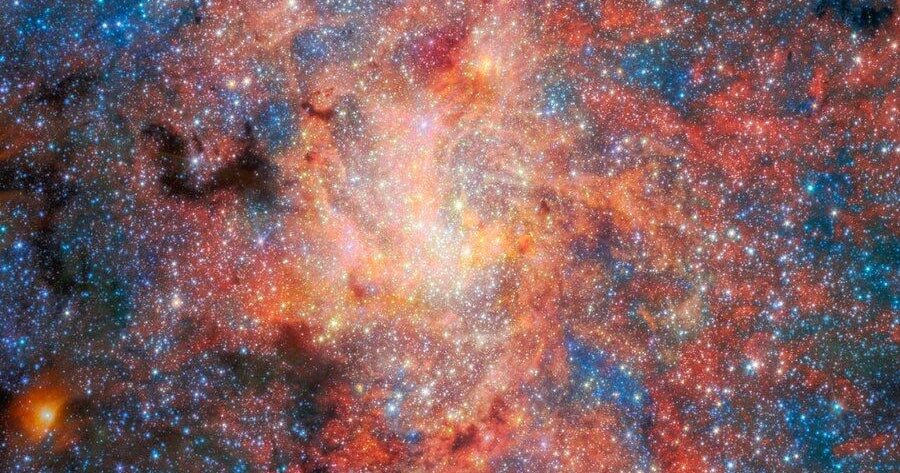
Separately, a team of astronomers announced on Tuesday that the Webb telescope revealed dust and water surviving in the extreme environment of a star located near the Milky Way’s central black hole. Scientists say the new observations provide the most detailed mid-infrared view yet of the star IRS 3, which is located just 0.55 light-years from Sagittarius A*, the Milky Way galaxy’s central supermassive black hole.
By analyzing the star’s infrared light with the Webb telescope, the research team identified signs of oxygen-rich dust and, for the first time, detected water in the star’s surrounding envelope. The results show that evolved stars like IRS 3 can still produce dust and other materials important for the creation of future stars – even under the harsh conditions near a supermassive black hole.
“Galactic centers are among the most extreme environments, so understanding whether stars can continue enriching their surroundings there is an important question,” said lead author Florian Peißker of the University of Cologne in Germany. “With Webb, we can directly observe how stars behave under these conditions and see that dust production remains remarkably resilient.”
Original source: https://www.cbsnews.com/entertainment/
Author

seoexperts1994@gmail.com
Related Posts

Trump says he offered UFC CEO Dana White the White House press secretary role
- 0
- 210 words
November 7, 2026 / 5:27 PM EST / CBS News President Trump says he has offered the open White House press secretary...
Read out all
2 licensed skydivers die after midair collison in California
- 0
- 208 words
November 7, 2026 / 10:52 AM EST / CBS/AP Two skydivers who were taking part in an organized skydiving event in California...
Read out all
Mass shooting in Krakow, Poland market leaves at least 5 dead, a dozen injured
- 0
- 211 words
Updated on: November 7, 2026 / 11:06 AM EST / CBS News A man drove into an open market in the Polish...
Read out all
Zelenskyy accuses Russia of ramping up attacks on Ukraine ahead of U.S. talks
- 0
- 209 words
November 7, 2026 / 9:20 AM EST / CBS/AP Missile attacks struck across Ukraine on Saturday, wounding at least nine people, as...
Read out all
Trump installs Stephen Miller as White House chief of staff, replacing Susie Wiles
- 0
- 205 words
Updated on: November 6, 2026 / 8:40 PM EST / CBS News Washington — President Trump moved Friday to install longtime aide...
Read out all
Paraguay’s ousted president under house arrest after bank collapse leaves millions locked out of accounts
- 0
- 210 words
November 7, 2026 / 5:12 AM EST / CBS/AP Paraguay's president has been placed on house arrest on Friday after the collapse...
Read out all