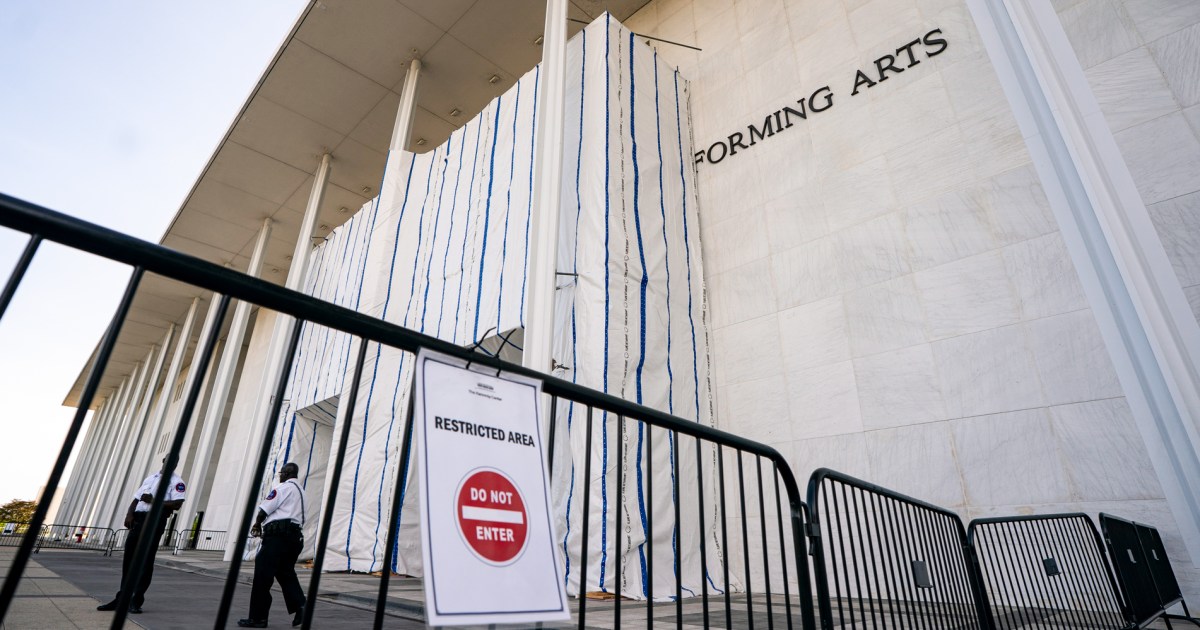
The Trump-appointed Kennedy Center board voted Thursday to partially close the iconic arts center for up to two years during renovations and to re-add President Donald Trump’s name to the building’s facade, according to a person who attended the virtual board meeting and a second person familiar with the meeting.
The decision would close the Kennedy Center’s main building and keep a smaller addition, known as the Reach, open for some events in response to a May court order requiring the board to maintain the center as a memorial to President John F. Kennedy.
After an almost two-hour Zoom meeting, the board voted 20-3 to change the name of the building to “The John F. Kennedy Center for the Performing Arts Restored and Renovated by President Donald J. Trump” and the physical location to “President Donald J. Trump Plaza.” Commerce Secretary Howard Lutnick proposed the name change.
Trump, who appointed himself chairman of the board last year, joined the call for several minutes, according to the source who attended the meeting.
The three people voting against it are the ex officio members from Congress, Rep. Joyce Beatty, D-Ohio; Sen. Sheldon Whitehouse, D-R.I.; and Rep. Rick Larsen, D-Wash.
“This latest development is a transparent effort to circumvent the Court’s ruling, and flies in the face of the statutes that Congress passed,” Beatty, who was one of the plaintiffs in a lawsuit challenging the Kennedy Center’s renaming, said in a statement. “I will continue to fight for this treasured national monument.”
Attorneys for Beatty said in a statement that the new naming effort appears to defy a judge’s ruling this year that the center’s board does not have the authority to rename what was intended as a “living memorial” for an assassinated president.
“A federal judge already rejected the board’s unlawful attempt to rename the Kennedy Center, and told Donald Trump’s handpicked board that its last closure vote was ill-informed and preordained. Today’s vote is more of the same, and a show of blatant disrespect to the courts,” said the lawyers, Norm Eisen of Democracy Defenders Action and Nathaniel Zelinsky of Washington Litigation Group.
U.S. District Judge Christopher Cooper’s order in May, which temporarily blocked the Kennedy Center’s planned closure last month, also asked that the board provide a financial plan to justify the decision to close it. Keeping the smaller venue open would allow ticket sales for some events, including performances by the National Symphony Orchestra, which is the Kennedy Center’s chief tenant.
The orchestra has performed there since the early 1970s, when the center — conceived by Jaqueline Kennedy as a memorial to her slain husband — opened.
In recent years, under the baton of music director and principal conductor Giancarlo Noseda, it has been rising in stature — but its future is now uncertain because the Kennedy Center’s Concert Hall will not be available. A search for other venues in the area has been underway.
The Kennedy Center’s future has been in limbo for months as Trump moves to reshape the iconic art institution in his image, one of several major Washington renovation projects.
After Trump named himself the Kennedy Center’s chairman last year and filled its board with allies, the board voted unanimously in March to close the center for two years for renovations.
Cooper’s order temporarily blocked the construction work and ordered that Trump’s name be removed, which it was in June.
He also said the board could still ultimately close the center “should it come to this decision anew after independently balancing its multiple obligations to the Center in a prudent fashion.”
Cooper also found the board did not have the authority to rename the center or add a name to it without the approval of Congress, which initially named it.
“The Kennedy Center’s organic statute makes crystal clear that the Center is to be named for President Kennedy, and it cannot bear any other formal name or public memorial based on the Board’s unilateral say-so,” Cooper said in his May decision.
“May the John F. Kennedy Center for the Performing Arts be renamed absent Congressional authorization? The answer, plain from the face of the statute, is no. Nor can any other individual be memorialized on the front portico of the building. Congress gave the Kennedy Center its name, and only Congress can change it.”
The decision to close the center and add Trump’s name to the building has sparked outrage from the administration’s critics, as well as members of the Kennedy family.
Former Rep. Joseph Kennedy III, a grandnephew of the late president, said in a statement last year that the center “is a living memorial to a fallen president and named for President Kennedy by federal law. It can no sooner be renamed than can someone rename the Lincoln Memorial, no matter what anyone says.”