
- 0
- 666 words
Exotic snakes, lizards found hidden in pillowcases in smuggling scheme
 Jeanine Santucci
Officers at the U.S.-Mexico border uncovered dozens of exotic reptiles hidden in pillowcases in a plot to smuggle protected species across the border, authorities said.
Two people have been arrested and charged with wildlife trafficking in what federal officials said was a yearslong smuggling operation. Georgina Bribiesca Chavez, of Tijuana, Mexico, was trying to cross the border into the United States at the San Ysidro Port of Entry between San Diego and Tijuana on Aug. 10 and told a Custom and Border Protection officer she had no items with her to declare upon entry, according to a news release from the Department of Justice.
The officer discovered Chavez had an arrest warrant for an ongoing trafficking investigation and took her into custody. When she was taken into custody and her vehicle, a red Volkswagen, was seized, Chavez didn’t alert officers about anything in her car, the U.S. Attorney’s Office for the Southern District of California said.
It wasn’t until a day later that officers searching the Volkswagen uncovered a hidden compartment behind the back seat, and inside, pillowcases that had been knotted up and sealed with tape. When an officer saw one of the pillowcases was moving, backup was called in.
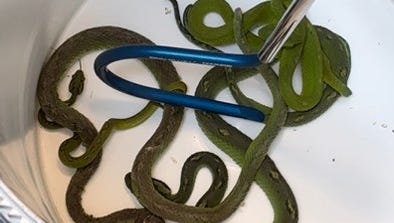
The pillowcases were opened carefully at the San Diego Zoo, the DOJ said. Inside were 60 abronia lizards, four venomous yellow-blotched palm pit vipers, three caimans, one baby crocodile and one indigo snake. Several of the animals are considered endangered or protected, officials said.
“Even after her arrest, Chavez never told CBP officers about the live animals in her car, leaving them abandoned for nearly 24 hours in the August heat in San Ysidro,” the Justice Department said.

All three caimans died, the DOJ said. The other animals were being cared for by zoo staff.
“These animals were not cargo – they were living creatures subjected to dangerous conditions for profit,” U.S. Attorney Adam Gordon said in a statement.
Chavez and an alleged trafficking partner, Salvador Pelayo of Chula Vista, California, have both been arrested and charged with violating the federal Lacey Act against trafficking. They could face up to five years in prison and a $250,000 fine if convicted. Both are being held without bond, officials said.
It wasn’t immediately clear if Chavez or Pelayo had an attorney who could speak on either’s behalf. USA TODAY has reached out to the Federal Defenders of San Diego, the federal public defender’s office for the Southern District of California.
Suspects involved in yearslong wildlife smuggling operation, prosecutors say
Prosecutors said Chavez and Pelayo began working together in 2023 to traffic wildlife to sell to American buyers, and were being investigated in an undercover operation by the U.S. Fish and Wildlife Service for the last 18 months.
On several occasions throughout the investigation, the pair sold protected species to undercover agents and were seen sending or receiving wildlife at shipping centers around San Diego, officials said.

In March 2025, undercover agents bought four protected Mexican box turtles from Pelayo and a partner in Mexico. Chavez delivered the animals to an undercover agent hours after crossing the border and was paid $2,600 in cash. Prosecutors said the turtles were taken to Oakland Zoo for care, and were identified as a protected species. The turtles were in bad health and all died by May 2025.
In another sale in March 2025, an undercover agent purchased Mexican and Yucatan box turtles to be shipped to New York, and Pelayo used a fake name, “Jose Lopez,” to ship them, prosecutors said. Those turtles were taken to the Buffalo Zoo for care.
The pair allegedly received tens of thousands of dollars over the course of their operation, according to the DOJ. They would also sometimes smuggle animals from the United States and sell them to buyers in Mexico, prosecutors said.
Original source: https://www.usatoday.com/news/nation/
Author

seoexperts1994@gmail.com
Related Posts

North Korea launches 10 missiles as US-South Korea drills near end
- 0
- 512 words
WORLDNorth KoreaNorth Korea launches 10 missiles as US-South Korea drills near endJoyce Lee and Kyu-seok ShimReutersAug. 20, 2026, 9:00 a.m. ETSEOUL –...
Read out all
Sismos en México: Veracruz registró el movimiento más fuerte
- 0
- 433 words
WORLDMexicoSismos en México: Veracruz registró el movimiento más fuerte Boris Q'vaUSA TODAY NETWORKAug. 20, 2026, 11:30 a.m. ETMéxico cerró el 19 de...
Read out all
Magnitude 6.7 earthquake strikes central Peru, USGS says
- 0
- 176 words
WORLDPeruMagnitude 6.7 earthquake strikes central Peru, USGS saysMarco AquinoReutersAug. 20, 2026, 9:41 p.m. ETLIMA, Peru — An earthquake of magnitude 6.7 hit...
Read out allCan ASU teach what influencers learn the hard way?
- 0
- 144 words
More VideosRussia sanctions bill isn't about sanctions. It's about tariffs.Trump’s chaotic trade policy continues to face legal challengesSee neighbor recall hearing EMS...
Read out all
‘The streets are empty’: How Miami’s Little Haiti reacted to losing TPS
- 0
- 2,101 words
NATIONDonald Trump'The streets are empty': How Miami's Little Haiti reacted to losing TPS Chris KenningUSA TODAYUpdated Aug. 20, 2026, 5:47 p.m. ETMIAMI...
Read out allIs content creation worth the cost of a college degree? | The Excerpt
- 0
- 1,923 word
NATIONArizona State UniversityIs content creation worth the cost of a college degree? | The Excerpt Dana TaylorUSA TODAYUpdated Aug. 20, 2026, 10:33...
Read out all