
- 0
- 666 words
Exotic snakes, lizards found hidden in pillowcases in smuggling scheme
 Jeanine Santucci
Officers at the U.S.-Mexico border uncovered dozens of exotic reptiles hidden in pillowcases in a plot to smuggle protected species across the border, authorities said.
Two people have been arrested and charged with wildlife trafficking in what federal officials said was a yearslong smuggling operation. Georgina Bribiesca Chavez, of Tijuana, Mexico, was trying to cross the border into the United States at the San Ysidro Port of Entry between San Diego and Tijuana on Aug. 10 and told a Custom and Border Protection officer she had no items with her to declare upon entry, according to a news release from the Department of Justice.
The officer discovered Chavez had an arrest warrant for an ongoing trafficking investigation and took her into custody. When she was taken into custody and her vehicle, a red Volkswagen, was seized, Chavez didn’t alert officers about anything in her car, the U.S. Attorney’s Office for the Southern District of California said.
It wasn’t until a day later that officers searching the Volkswagen uncovered a hidden compartment behind the back seat, and inside, pillowcases that had been knotted up and sealed with tape. When an officer saw one of the pillowcases was moving, backup was called in.
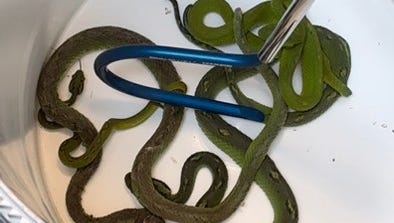
The pillowcases were opened carefully at the San Diego Zoo, the DOJ said. Inside were 60 abronia lizards, four venomous yellow-blotched palm pit vipers, three caimans, one baby crocodile and one indigo snake. Several of the animals are considered endangered or protected, officials said.
“Even after her arrest, Chavez never told CBP officers about the live animals in her car, leaving them abandoned for nearly 24 hours in the August heat in San Ysidro,” the Justice Department said.

All three caimans died, the DOJ said. The other animals were being cared for by zoo staff.
“These animals were not cargo – they were living creatures subjected to dangerous conditions for profit,” U.S. Attorney Adam Gordon said in a statement.
Chavez and an alleged trafficking partner, Salvador Pelayo of Chula Vista, California, have both been arrested and charged with violating the federal Lacey Act against trafficking. They could face up to five years in prison and a $250,000 fine if convicted. Both are being held without bond, officials said.
It wasn’t immediately clear if Chavez or Pelayo had an attorney who could speak on either’s behalf. USA TODAY has reached out to the Federal Defenders of San Diego, the federal public defender’s office for the Southern District of California.
Suspects involved in yearslong wildlife smuggling operation, prosecutors say
Prosecutors said Chavez and Pelayo began working together in 2023 to traffic wildlife to sell to American buyers, and were being investigated in an undercover operation by the U.S. Fish and Wildlife Service for the last 18 months.
On several occasions throughout the investigation, the pair sold protected species to undercover agents and were seen sending or receiving wildlife at shipping centers around San Diego, officials said.

In March 2025, undercover agents bought four protected Mexican box turtles from Pelayo and a partner in Mexico. Chavez delivered the animals to an undercover agent hours after crossing the border and was paid $2,600 in cash. Prosecutors said the turtles were taken to Oakland Zoo for care, and were identified as a protected species. The turtles were in bad health and all died by May 2025.
In another sale in March 2025, an undercover agent purchased Mexican and Yucatan box turtles to be shipped to New York, and Pelayo used a fake name, “Jose Lopez,” to ship them, prosecutors said. Those turtles were taken to the Buffalo Zoo for care.
The pair allegedly received tens of thousands of dollars over the course of their operation, according to the DOJ. They would also sometimes smuggle animals from the United States and sell them to buyers in Mexico, prosecutors said.
Original source: https://www.usatoday.com/news/nation/
Author

seoexperts1994@gmail.com
Related Posts
Mayor moves to ban Cornell event permits after rape allegations
- 0
- 211 words
The mayor of Ithaca, the New York city home to Cornell University, called for a ban on student event and special event...
Read out all
Federal court halts execution of Christa Pike in 11th hour
- 0
- 211 words
A federal court has stayed the execution of Christa Pike less than two hours before it was set to be carried out....
Read out all
‘A tired refrain.’ Critics fight adding Trump’s name to Kennedy Center
- 0
- 220 words
WASHINGTON – President Donald Trump's opponents to putting his name on the Kennedy Center called his argument that the venue would fail...
Read out all
Israel-bound jet lands in Saudi Arabia after apparent pilot fight
- 0
- 214 words
A commercial passenger jet bound for Tel Aviv from Dubai made an emergency landing in Saudi Arabia after an apparent fight broke...
Read out all
Trump to send $500 ACA refund checks to nearly 1 million Americans
- 0
- 204 words
WASHINGTON — President Donald Trump is set on Sept. 30 to start sending $500 checks to nearly 1 million Americans his administration...
Read out all
In 2016, Gretchen Carlson’s lawyer warned: “They’ll kill you”
- 0
- 124 words
More VideosThe battle to stop deepfake abuse before it spreadsSee shark swim in severe New Jersey floodingWhy are so many ICE employees...
Read out all