- 0
- 680 words
How to get a good photo of the partial solar eclipse
 Melina Khan
While the United States is not in the path of totality for the Aug. 12 solar eclipse, there is still a chance to catch a glimpse of the partial eclipse in some areas.
During the event, the moon will slip in front of the sun, creating a total solar eclipse visible in some countries such as Greenland, Iceland and Spain, according to NASA.
Some parts of the northern United States will be able to get a partial glimpse. According to NASA, a partial solar eclipse occurs when the moon passes between the sun and earth, but the three are not perfectly lined up. Instead, only a part of the sun will appear to be covered, giving it a crescent shape.
For those looking to capture the moment, here’s what to know about taking the best photo of the eclipse.

Tips for taking a good solar eclipse photo

Those looking to catch a glimpse of the partial solar eclipse may also be looking to capture the moment on camera.
Justin Patricolo, a photographer at MPB, and Timothy McCarty, a photographer who runs the website zoomwithourfeet.com, both shared tips with USA TODAY for taking eclipse photos:
Protect eyes and camera gear
Because the moon does not completely block the sun during a partial solar eclipse, it is not safe to look directly at the eclipse without proper eye protection, according to NASA.
The same method applies to cameras, Patricolo and McCarty said.
Anyone taking photos of the eclipse should ensure they have a solar filter to protect their camera sensor as well.
Make sure your camera is stable
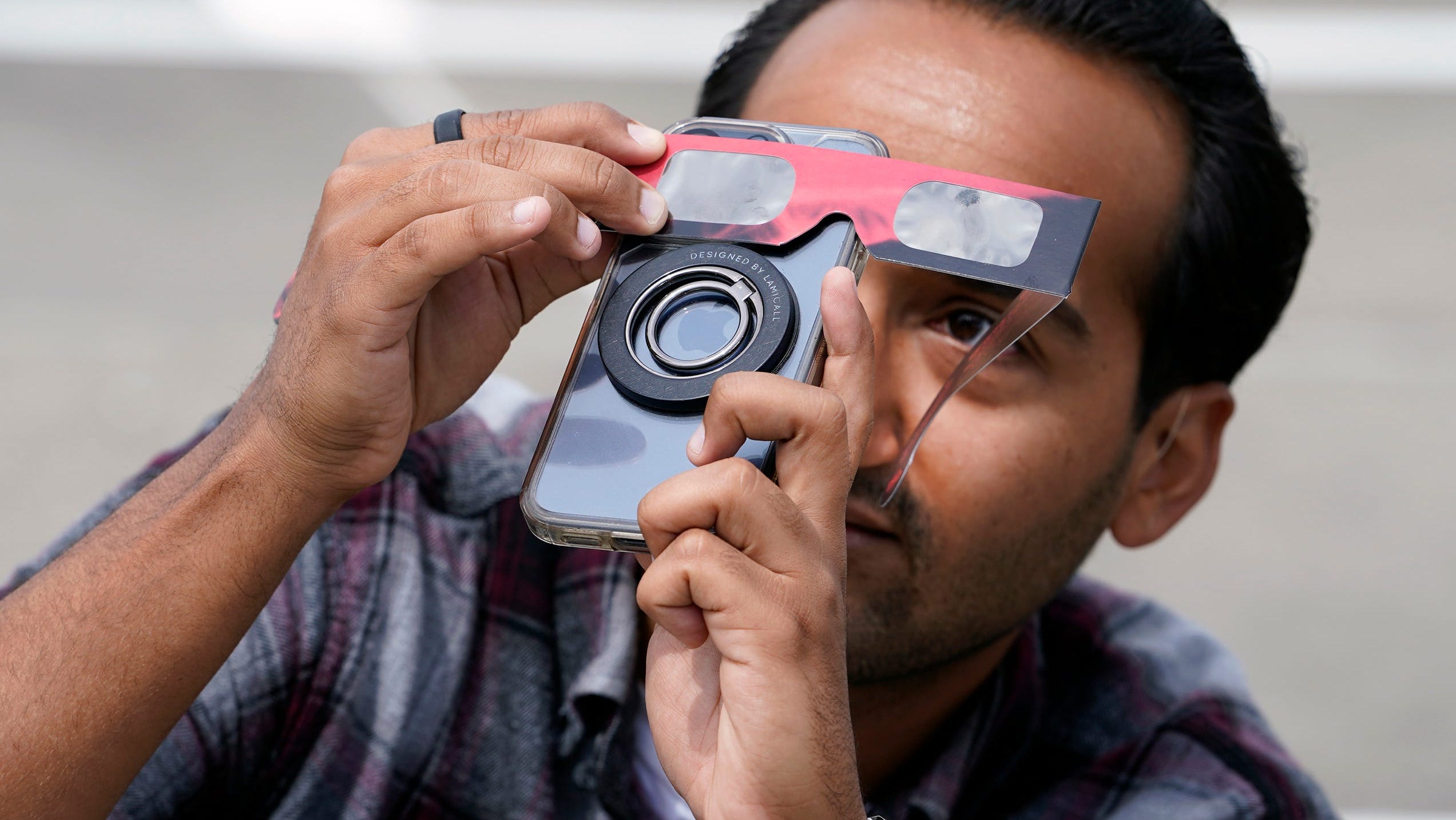
Using a tripod or phone holder is the best way to keep your camera stable, because even slight movement equals blur.
“Given the distance, your phone or camera must be rock solid to take images in focus,” McCarty said.
Scout a location
Plan ahead to scout a location from where to take photos. For example, find an open area with a clear view of the sky, especially toward the sun’s horizon, Patricolo said.
Adjust settings
Play with aperture, shutter speed and ISO to determine the best settings for the photo, McCarty said. Those using a phone can download a manual camera app to control these settings.
“Most phones expose for the middle, so when something is extremely bright, like the sun, they tend to overcompensate,” McCarty said.
Tips for using a phone to take eclipse photos
Many people will be taking photos with their phones. In that case, McCarty recommends the following tips:
Switch to video mode
Make sure to adjust your phone’s settings to record in 4K rather than the standard 1080p. Record 10-20 seconds then take a screenshot from the video.
“It sounds crazy, but it works,” McCarty said.
Lower exposure
Zoom in and lower the exposure. On iPhone, that means dragging the sun icon down.
“You’ll often end up with a much better exposed image than you would in photo mode,” McCarty added.
Use a solar filter
Even for phones, McCarty recommends using an ISO-certified solar filter over the lens to handle the power of the sun.
“The filter allows you to shoot directly at the sun while lowering the exposure enough to capture a usable image,” McCarty said.
Which states will see partial solar eclipse?
The partial solar eclipse will be visible in about 26 states and Washington, DC, according to Time and Date and NASA.
See the full list, according to Time and Date:
- Alaska
- Connecticut
- Delaware
- Illinois
- Indiana
- Iowa
- Kentucky
- Maine
- Maryland
- Massachusetts
- Michigan
- Minnesota
- Montana
- New Hampshire
- New Jersey
- New York
- North Carolina
- North Dakota
- Ohio
- Pennsylvania
- Rhode Island
- South Dakota
- Vermont
- Virginia
- Washington, DC
- West Virginia
- Wisconsin
See the map below for states included in the partial coverage area:
Melina Khan is a national trending reporter for USA TODAY. Keep up with her on X @melinakh and Instagram @bymelinakhan.
Original source: https://www.usatoday.com/news/nation/
Author

seoexperts1994@gmail.com
Related Posts
Mayor moves to ban Cornell event permits after rape allegations
- 0
- 211 words
The mayor of Ithaca, the New York city home to Cornell University, called for a ban on student event and special event...
Read out all
Federal court halts execution of Christa Pike in 11th hour
- 0
- 211 words
A federal court has stayed the execution of Christa Pike less than two hours before it was set to be carried out....
Read out all
‘A tired refrain.’ Critics fight adding Trump’s name to Kennedy Center
- 0
- 220 words
WASHINGTON – President Donald Trump's opponents to putting his name on the Kennedy Center called his argument that the venue would fail...
Read out all
Israel-bound jet lands in Saudi Arabia after apparent pilot fight
- 0
- 214 words
A commercial passenger jet bound for Tel Aviv from Dubai made an emergency landing in Saudi Arabia after an apparent fight broke...
Read out all
Trump to send $500 ACA refund checks to nearly 1 million Americans
- 0
- 204 words
WASHINGTON — President Donald Trump is set on Sept. 30 to start sending $500 checks to nearly 1 million Americans his administration...
Read out all
In 2016, Gretchen Carlson’s lawyer warned: “They’ll kill you”
- 0
- 124 words
More VideosThe battle to stop deepfake abuse before it spreadsSee shark swim in severe New Jersey floodingWhy are so many ICE employees...
Read out all