
- 0
- 1,086 word
Aug. 12 eclipse nothing compared to April 2024 spectacle. A look back
Feeling nostalgic for the 2024 total solar eclipse? Here’s what you’ll see on Aug. 12 in parts of the United States.
 Eric Lagatta
- The total solar eclipse on April 8, 2024, captivated millions across the United States.
- A partial solar eclipse, where the moon only partly covers the sun, will be visible in parts of the U.S. on August 12.
- The next total solar eclipse visible in the contiguous United States will not occur until August 2044.
Few, if any, celestial events have ever had the power to capture our collective attention the way the total solar eclipse did more than two years ago.
On April 8, 2024, millions of Americans paused their days to step outside to witness an incredibly rare sight. When totality reached cities across the U.S., schools let out, work was put on hold and people took a moment to witness what was very likely a once-in-a-lifetime cosmic display.
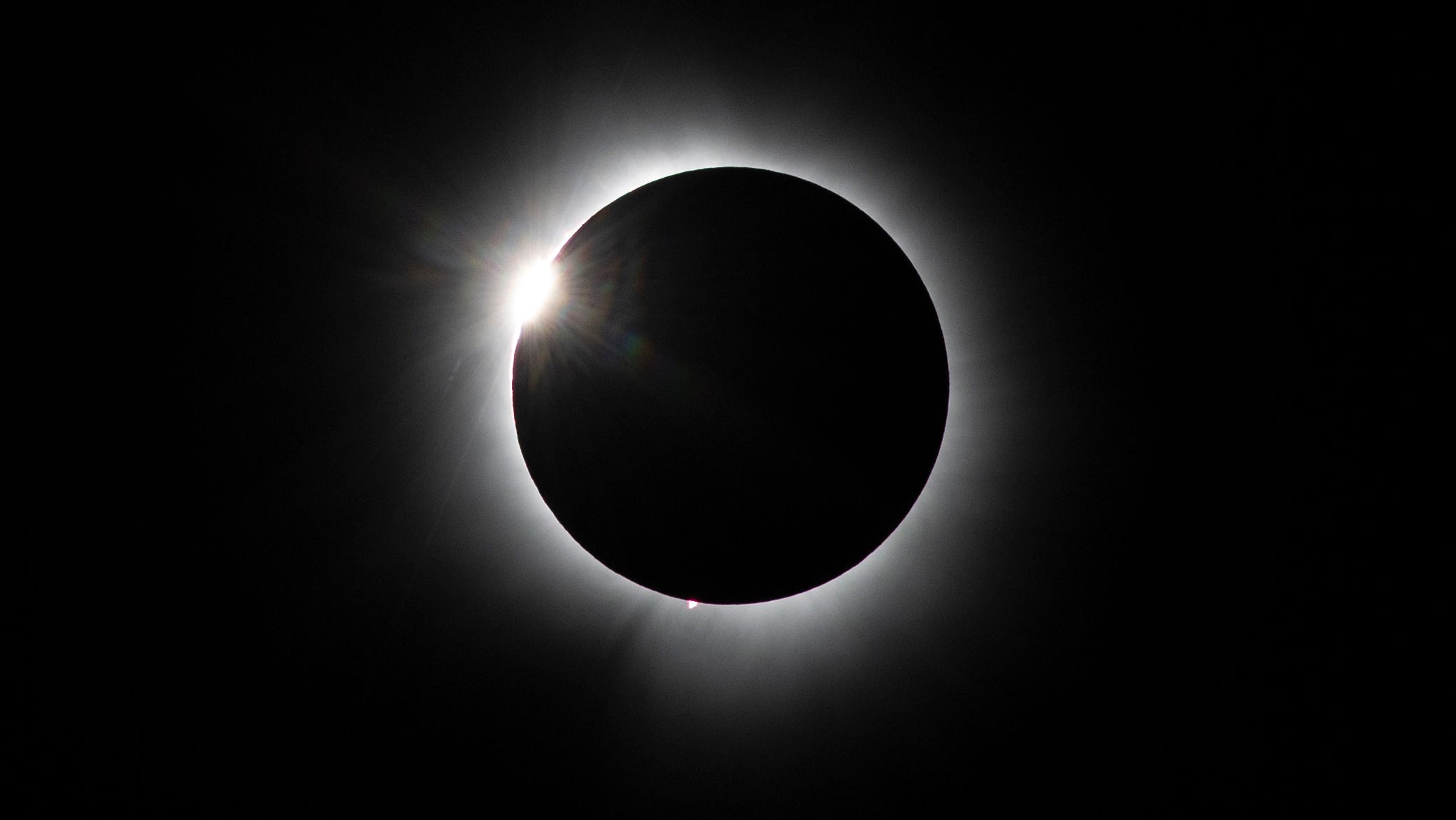
For many spectators, the weeks of social media hype and frenzied media coverage leading up to the last total solar eclipse had paid off. Those in the eclipse’s path were treated to an incredible display as the moon completely blotted out the sun and revealed its outermost layer, which for a few minutes appeared as a striking glowing ring.
If you missed out on the event, or it left you wanting more, you may be in for some slight disappointment. That’s because what occurred in 2024 is not exactly what will happen Aug. 12 when a partial solar eclipse is unveiled in parts of the United States, from Alaska to North Carolina.

Here’s a recap of the April 2024 total solar eclipse and how the upcoming partial cosmic event will be a bit different.
What is a solar eclipse? How is it different from a lunar eclipse?
A solar eclipse is what occurs when the moon comes in between the sun and the Earth, resulting in a shadow being cast on our planet that either fully or partially blocks the sun’s light. That differs from what happens during a lunar eclipse, when the Earth came between the sun and moon to block sunlight from reaching our celestial neighbor.
What happened during the April 2024 total solar eclipse?
The 2024 total solar eclipse was the first in North America since 2017 and completely put its predecessor to shame.
During celestial display, the sun’s outermost layer, the corona, was brighter, the moon appeared larger and totality lasted just a bit longer than it did seven years prior.
The total solar eclipse of April 2024 charted a 115-mile-wide path across Mexico, the United States and maritime provinces of Canada. In the U.S., tens of millions of people lived in the path of totality – the area where the moon completely blotted out the sun’s disk stretching from the bottom of Texas all the way to the tip of Maine.
What did the Great American Eclipse look like?
During the April 2024 total solar eclipse, spectators in the path of totality witnessed a stunning sight as the Earth, sun and moon perfectly aligned for a few minutes. The process not only ushered in uncharacteristic darkness, but unveiled the outermost layer of the sun’s atmosphere.
Strange darkness blanketed a large swath of the U.S., animals fell silent, and a spectacular glowing ring appeared in the sky where the sun should have been.

What is the difference between a partial and total solar eclipse?

While a total solar eclipse is what occurs when the moon completely blocks the face of the sun from Earth, a partial solar eclipse is an imperfect alignment of the trio of celestial bodies.
Instead of darkening the sky and unveiling the sun’s signature circular ring, this time around the moon will only partly cover the sun, giving it a crescent shape, according to NASA. The sight will resemble someone taking a bite out of the sun.
When, where will today’s partial solar eclipse be visible?

While a total solar eclipse will be visible Aug. 12 to most of Europe and northwestern Africa, what some Americans will see will be a partial solar eclipse.
The eclipse begins around 11:34 a.m. ET and reaches its peak at 1:46 p.m. ET, according to the website TimeAndDate.
In the United States, some 26 states and Washington, DC, will have a chance to see a partial eclipse. In Alaska, the eclipse will happen in the morning, while those in the northern U.S. will be able to see it between midday and midafternoon.
Safety instructions differ for partial solar eclipse
Still have your safety eclipse glasses from 2024? That’s great!
Just like during the total solar eclipse, spectators should plan to wear proper safety glasses – thousands of times darker than normal sunglasses – or take steps to otherwise protect their eyes from the sun’s harmful rays.
But unlike during the total solar eclipse, there is no time during a partial solar eclipse when it is safe for skygazers to view the spectacle with the naked eye. Before, those in the eclipse’s path had a few brief moments during totality where the sun was shielded and they could safely remove eyewear to take in the sight.
Because the sun will never be completely covered this time around, observers are cautioned to use proper eye protection at all times.
When is the next total solar eclipse in the US?
The awe-inspiring spectacle that is a total solar eclipse is a rarity – and will become even more so in the years ahead. While only seven years passed between total solar eclipses in North America, the next one visible in the continent won’t be for another two decades.
While NASA indicates the next total solar eclipse is in August 2027, it won’t be visible in North America.
Those in the U.S. will be waiting until Aug. 23, 2044, for a total solar eclipse. And with only three states on the path – Montana, North Dakota and South Dakota – the next North American eclipse won’t have nearly as big of a reach as the 2024 celestial event that blanketed 13 states.
Outside of the lower 48 states, Alaska is set to experience a total solar eclipse on March 30, 2033, according to nationaleclipse.com.
Contributing: Saleen Martin, Julia Gomez, Melina Khan, USA TODAY
Eric Lagatta is the Space Connect reporter for the USA TODAY Network. Reach him at elagatta@usatodayco.com
Original source: https://www.usatoday.com/news/nation/
Author

seoexperts1994@gmail.com
Related Posts

Mayor moves to ban Cornell event permits after rape allegations
- 0
- 211 words
The mayor of Ithaca, the New York city home to Cornell University, called for a ban on student event and special event...
Read out all
Federal court halts execution of Christa Pike in 11th hour
- 0
- 211 words
A federal court has stayed the execution of Christa Pike less than two hours before it was set to be carried out....
Read out all
‘A tired refrain.’ Critics fight adding Trump’s name to Kennedy Center
- 0
- 220 words
WASHINGTON – President Donald Trump's opponents to putting his name on the Kennedy Center called his argument that the venue would fail...
Read out all
Israel-bound jet lands in Saudi Arabia after apparent pilot fight
- 0
- 214 words
A commercial passenger jet bound for Tel Aviv from Dubai made an emergency landing in Saudi Arabia after an apparent fight broke...
Read out all
Trump to send $500 ACA refund checks to nearly 1 million Americans
- 0
- 204 words
WASHINGTON — President Donald Trump is set on Sept. 30 to start sending $500 checks to nearly 1 million Americans his administration...
Read out all
In 2016, Gretchen Carlson’s lawyer warned: “They’ll kill you”
- 0
- 124 words
More VideosThe battle to stop deepfake abuse before it spreadsSee shark swim in severe New Jersey floodingWhy are so many ICE employees...
Read out all