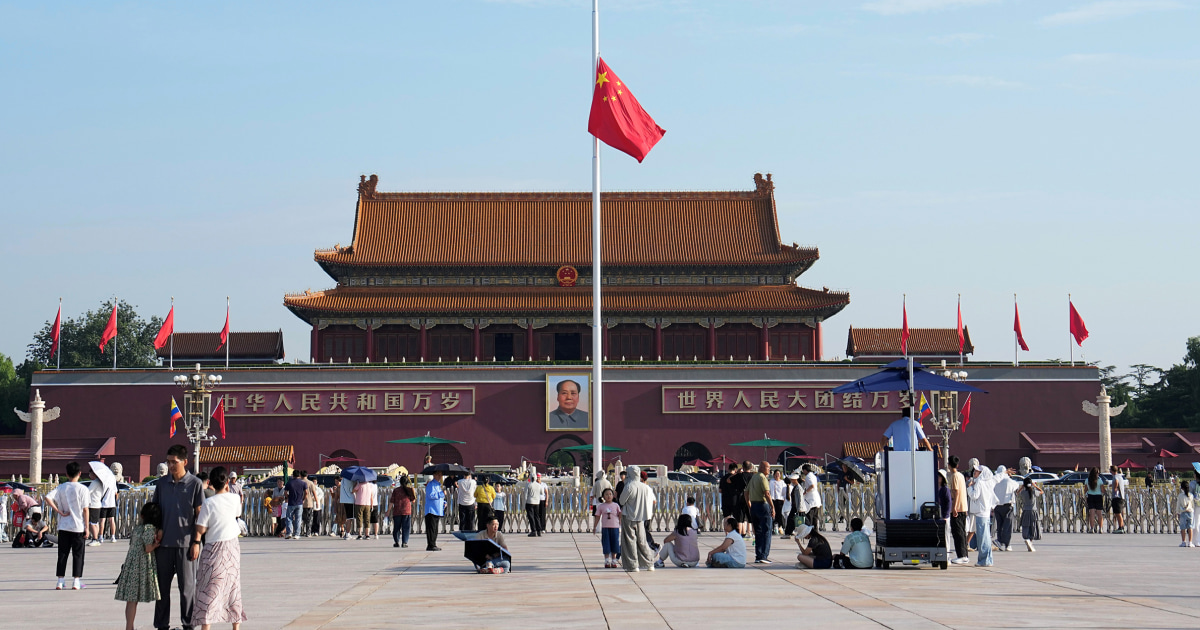
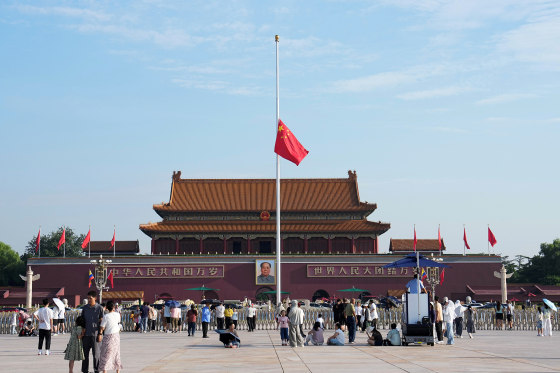
BEIJING — China consigned to the flames on Tuesday the body of former Premier Zhu Rongji, and lowered the national flag to mourn the no-nonsense reformer who died last week at age 97, as citizens recalled a bygone era and reflected on his complicated legacy.
Security was tight across the city, particularly around Tiananmen Square and the leaders’ enclave of Zhongnanhai, the center of political power, which lie on the route to the Babaoshan crematorium.
President Xi Jinping and the seven members of the Politburo standing committee stood in silence and made three bows before Zhu was cremated at the Beijing cemetery for top officials and national heroes, according to Xinhua, China’s state-run news agency.
Former President Hu Jintao, 83, who has missed a string of recent public events, sent a wreath of condolence for the former second-ranking official, it added.
As vice premier from 1991 to 1998 and premier from 1998 to 2003, Zhu helped drive China’s hard-edged economic overhaul in the 1990s.
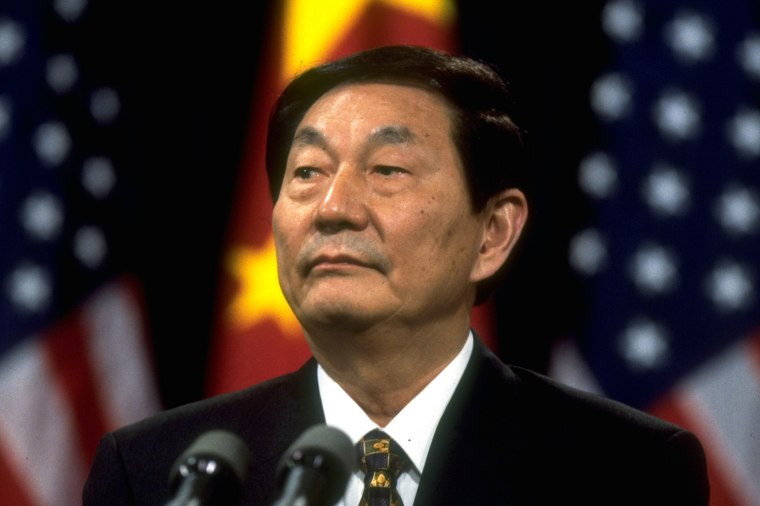
He curbed runaway inflation, tightened tax and banking systems, and pushed through a sweeping shake-up of the state sector that eliminated millions of jobs at unprofitable firms.
The reforms also helped clear the way for China’s accession to the World Trade Organization in 2001, foreshadowing integration with the global economy.
“My defining trait — my guiding principle — is independent thinking,” Zhu told officials in the commercial hub of Shanghai in 1988, before he became its mayor. “I believe I should say what I truly think.”
Zhu’s membership of the ruling Communist Party was revoked in the late 1950s, for an incautious three-minute speech, he said. It was not restored for roughly two decades.
His death brought an outpouring of mourning on Chinese social media, but a few welcomed it.
“As the child of laid-off workers, I’ll have to raise a glass tonight,” said a post later removed from Weibo, China’s version of X, after news of his death.
Another called Zhu “the main culprit” in putting people out of work, but others defended the iron-fisted premier.
“I know that quite a considerable number of ordinary people in China like me,” Zhu said in 2001.
“But there are also some who hate me to the core. How could one possibly make everyone love him?”
Like other former premiers who have died in the last decade, Zhu’s death was treated in subdued and tightly managed fashion, with public expressions of grief unfolding under heightened security, scrutiny and censorship.
Chinese authorities have long seen the deaths of popular former leaders as a potential trigger for a surge of public emotion, and an occasional catalyst for instability when remembrance of the dead turns into criticism of those in power.
Tens of thousands thronged Tiananmen Square and surrounding streets in Beijing in 1976, after the death of Zhou Enlai, the People’s Republic’s first and widely respected premier.
Their mourning became a protest against the excesses of the Cultural Revolution and radical officials associated with it.
In 1989, the death of Hu Yaobang, the former party general secretary, widely seen as sympathetic to political reform, prompted pro-democracy demonstrations that culminated in a bloody crackdown on Tiananmen Square.
But greater scrutiny has not stemmed the flow of memories about Zhu.
“People are still quite nostalgic for him … and some seemed genuinely moved and almost tearful,” said Zhao, a 39-year-old IT worker who gave only his surname.
The death took people back to how they felt 20 years ago, he added, soon after China adopted reforms and began opening up to the world, with the economy growing rapidly.