
- 0
- 460 words
NASA images show 60-foot-wide crater on moon after SpaceX rocket booster crash
A NASA spacecraft circling the moon is providing the sharpest views yet of the crater carved out by a crashing SpaceX rocket.
The space agency released before-and-after photos of the impact area on Tuesday.
The 8,800-pound SpaceX Falcon 9 rocket booster plowed into the moon at 5,400 miles per hour on Aug. 5 after drifting through space for more than a year. The rocket, which was about 45 feet long and 12 feet wide, crashed with a force of nearly 3 tons of TNT. The moon is regularly pelted by objects, but they are usually natural occurrences, like meteoroids. The number of artificial impacts is relatively small.
In January 2025, the SpaceX Falcon 9 rocket launched a pair of private moon landers with experiments and even a tiny rover as part of NASA’s push to commercialize lunar exploration. The upper stage of the rocket drifted in space before it eventually made its way toward the moon’s Earth-facing side before the lunar crash.
Based on these new photos by NASA’s Lunar Reconnaissance Orbiter, the fresh crater appears to be 60 feet across and less than 10 feet deep, according to scientists.
NASA via AP 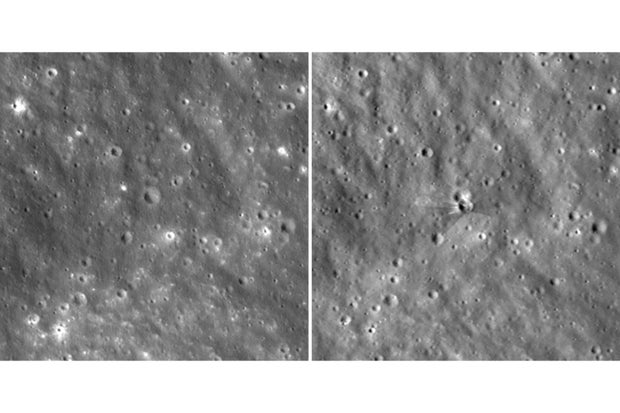
Dark and bright streaks are clearly visible, emanating like butterfly wings from the crater. The darker lines represent excavated material that was close to the surface and shaped by eons of solar wind, cosmic rays and micrometeorite strikes. The brighter rays indicate fresh rocks and dirt that were hurled from farther down.
The spacecraft photographed the crater a week after the collision from 60 miles up, while zooming along at 1 mile per second. Flight controllers had to tilt the spacecraft so its cameras pointed toward the impact scene.
The orbiter completes a lunar polar orbit every two hours, as the moon rotates beneath. It took six days before the crash scene came into view.
South Korea’s Danuri spacecraft was first on the scene to beam back photos.
The Lunar Reconnaissance Orbiter has been orbiting the moon since 2009, serving as NASA’s up-close eyes as the space agency works to return astronauts to the lunar surface.
In 2009, NASA intentionally crashed a rocket stage into a permanently shadowed crater at the moon’s south pole to search for water ice. The impact confirmed water ice exists at the location, helping make the region a prime target for future moon bases by the U.S. and China.
Original source: https://www.cbsnews.com/healthwatch/
Author

seoexperts1994@gmail.com
Related Posts
Hayden Panettiere was with on-and-off boyfriend Brian Hickerson when she died, police report says
- 0
- 687 words
U.S. Hayden Panettiere was with on-and-off boyfriend Brian Hickerson when she died, police report says By Kerry Breen News Editor Kerry Breen...
Read out allFrank Beard, ZZ Top drummer, dies at age 77
- 0
- 1,208 word
U.S. Frank Beard, ZZ Top drummer, dies at age 77 Updated on: August 18, 2026 / 5:37 PM EDT / CBS/AP Add...
Read out all
U.S. envoy in Turkey chastises Israel for “unnecessary escalation” with strikes on Syrian air base
- 0
- 451 words
World U.S. envoy in Turkey chastises Israel for "unnecessary escalation" with strikes on Syrian air base By Frank Andrews Frank Andrews is...
Read out all
32 years after American tourist Amy Lopez murdered in Germany, her alleged killer faces trial
- 0
- 470 words
Crime 32 years after American tourist Amy Lopez murdered in Germany, her alleged killer faces trial August 18, 2026 / 9:20 AM...
Read out allUkraine targets Moscow with huge drone strike as Russia warns U.K. will pay price for supplying attack drones
- 0
- 741 words
World Ukraine targets Moscow with huge drone strike as Russia warns U.K. will pay price for supplying attack drones By Aidan Stretch...
Read out allUSS Benfold, Navy destroyer, went days without power in the South China Sea
- 0
- 481 words
Politics USS Benfold, Navy destroyer, went days without power in the South China Sea By Charlie D'Agata Senior national security correspondent Charlie...
Read out all