

- 0
- 1,998 word
Solar eclipse live updates: Excitement mounts as totality approaches in Europe
It’s the first time a total solar eclipse will be visible from mainland Europe since 1999. Northern U.S. states will get a partial solar eclipse.
What to know<!–>
- qv q:id=4 q:key=JbNX:A<ahr0–>
- A total solar eclipse will be visible today from Spain, a small part of Portugal, Greenland, Iceland and northern Russia — the first time since 1999 that mainland Europe will be treated to the spectacle.
- Totality — when the moon fully blocks the sun — will mostly occur in the evening. In Reykjavík, Iceland, totality will begin at 5:48 p.m. (1:48 p.m. ET). In Valencia, Spain, it will start at 8:32 p.m. (2:32 p.m. ET).
- Most of Europe, Canada and northwestern Africa, along with parts of the northern U.S., will see a partial solar eclipse. In Anchorage, Alaska, it began at 7:36 a.m. local time; In New York City, it will start at 1:07 p.m. ET.
- NBC News’ Raf Sanchez is reporting from Valladolid, Spain, and Daniele Hamamdjian from the Royal Observatory in London.
In Spain, tourists and locals gather on hillsides<!–>
Large crowds — locals and tourists alike — have gathered at the Cerro de Contienda, a hilly park outside Valladolid in northern Spain.

Crowds in a park in Valladolid.<!–> t=o–>Sara Monetta / NBC News<!–>
/qv–>
Among them is the Fullmer family, who traveled all the way from Las Vegas to witness the celestial event.

The Fullmer family.<!–> t=w–>Sara Monetta / NBC News<!–>
/qv–>
One of the their children, Max, turns 3 years old today. The crowd sang “happy birthday” to him as he blew out a candle on his cake.
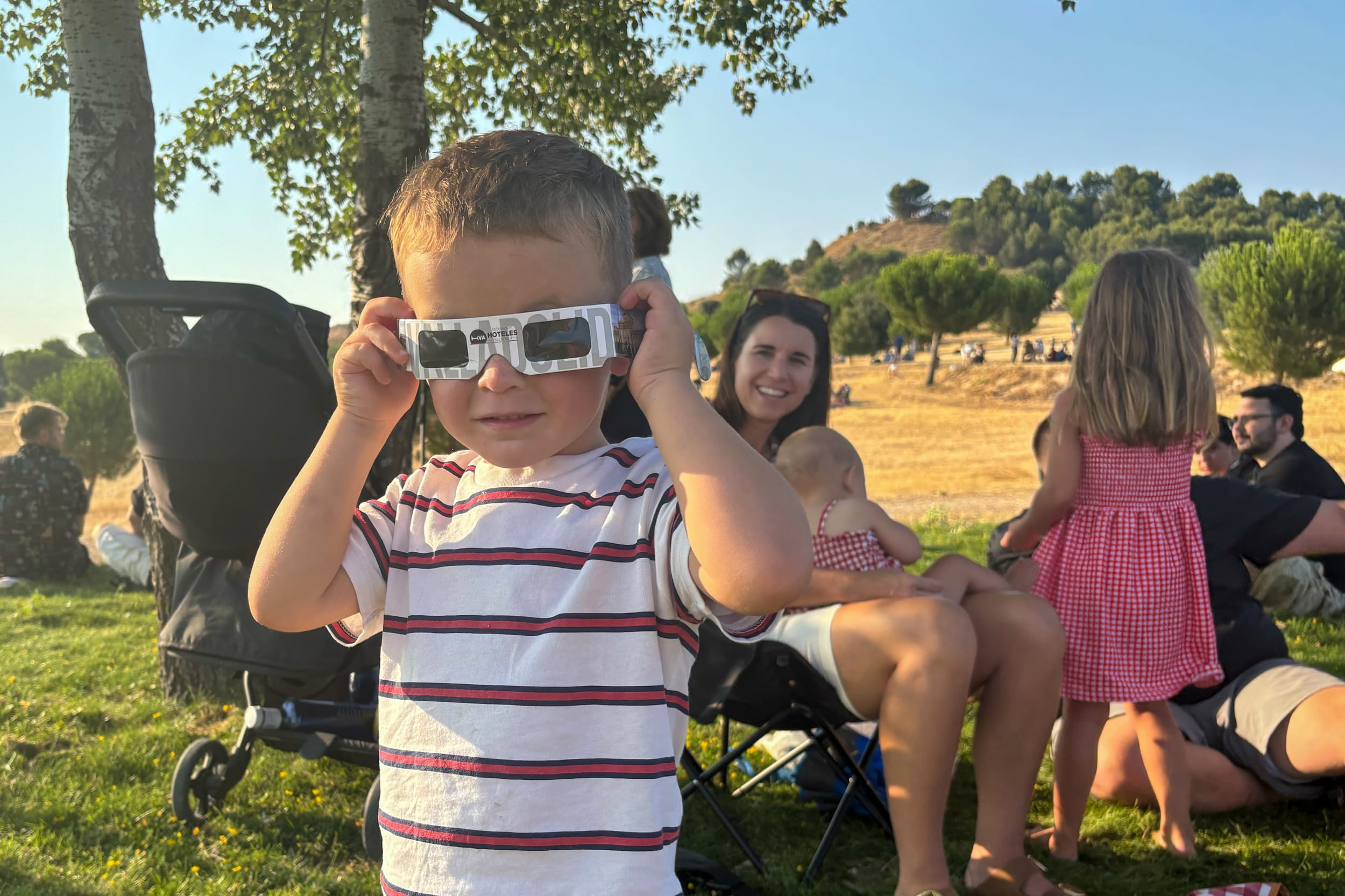
Max Fullmer, 3, wearing protective solar eclipse glasses.<!–> t=14–>Sara Monetta / NBC News<!–>
/qv–>
Cloudy weather spoils some eclipse views in Iceland and Ireland<!–>
Unpredictable weather is always the bane of eclipse chasing — and today’s event has been no different.
Skywatchers in Iceland and Ireland were hoping for a break in the clouds to view the total solar eclipse, but many struck out.
Totality is over in Iceland<!–>
Totality — the period when the moon fully blocks the sun’s light — has come and gone in the “Land of Fire and Ice,” though cloudy weather has thwarted the views for some.
In Reykjavík, the moon started passing in front of the sun at 4:47 p.m. local time (12:47 p.m. ET), then totality began at 5:48 p.m. (1:48 p.m. ET) and lasted for about one minute.
The moon will continue blocking part of the sun’s light as it continues its march. The partial solar eclipse will end at 6:47 p.m. local time (2:47 p.m. ET).
Across Europe, eclipse viewers get ready<!–>
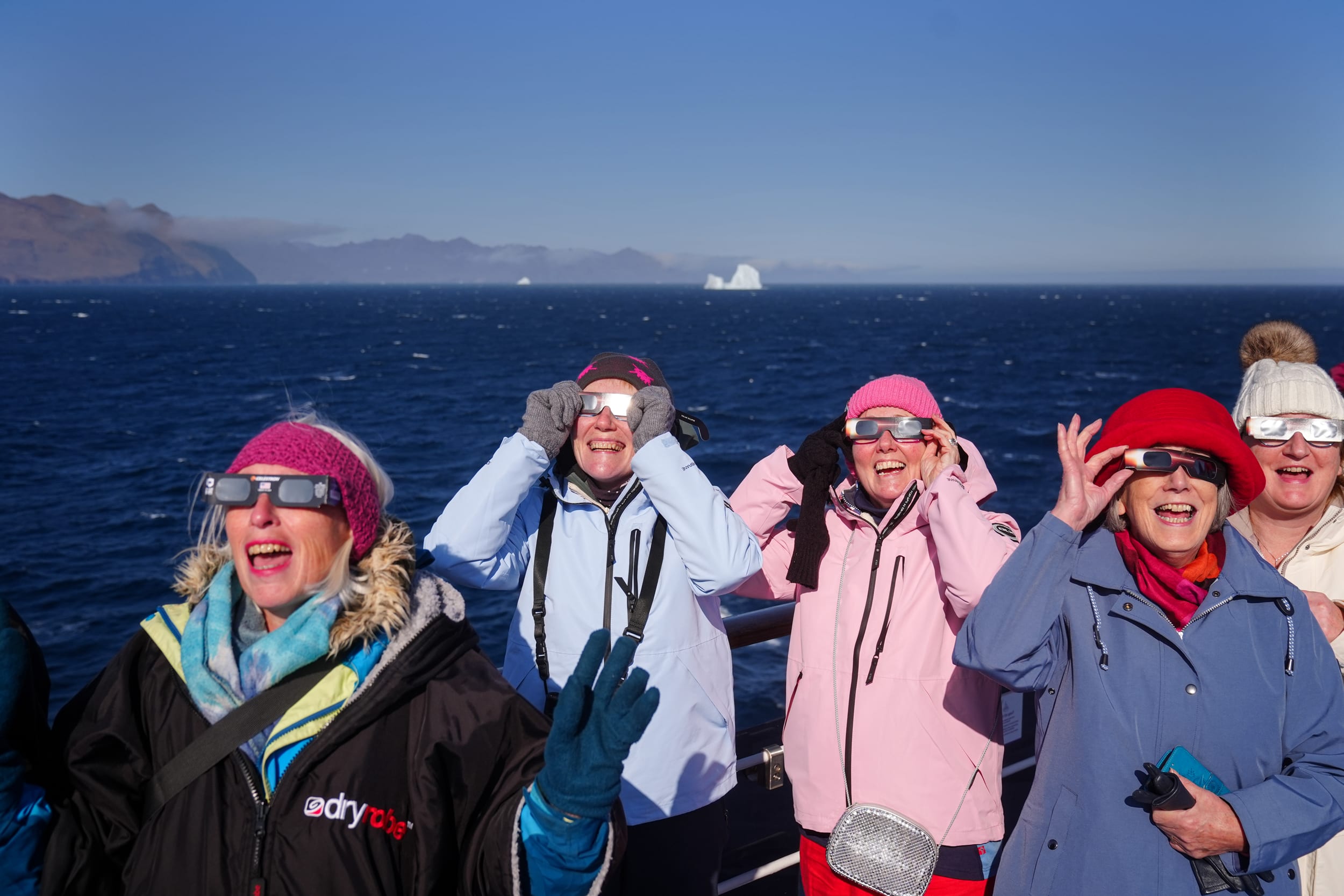
Passengers on board a cruise ship watch the start of the total solar eclipse off the coast of Greenland.<!–> t=26–>Owen Humphreys / PA Images via Getty Images<!–>
/qv–>
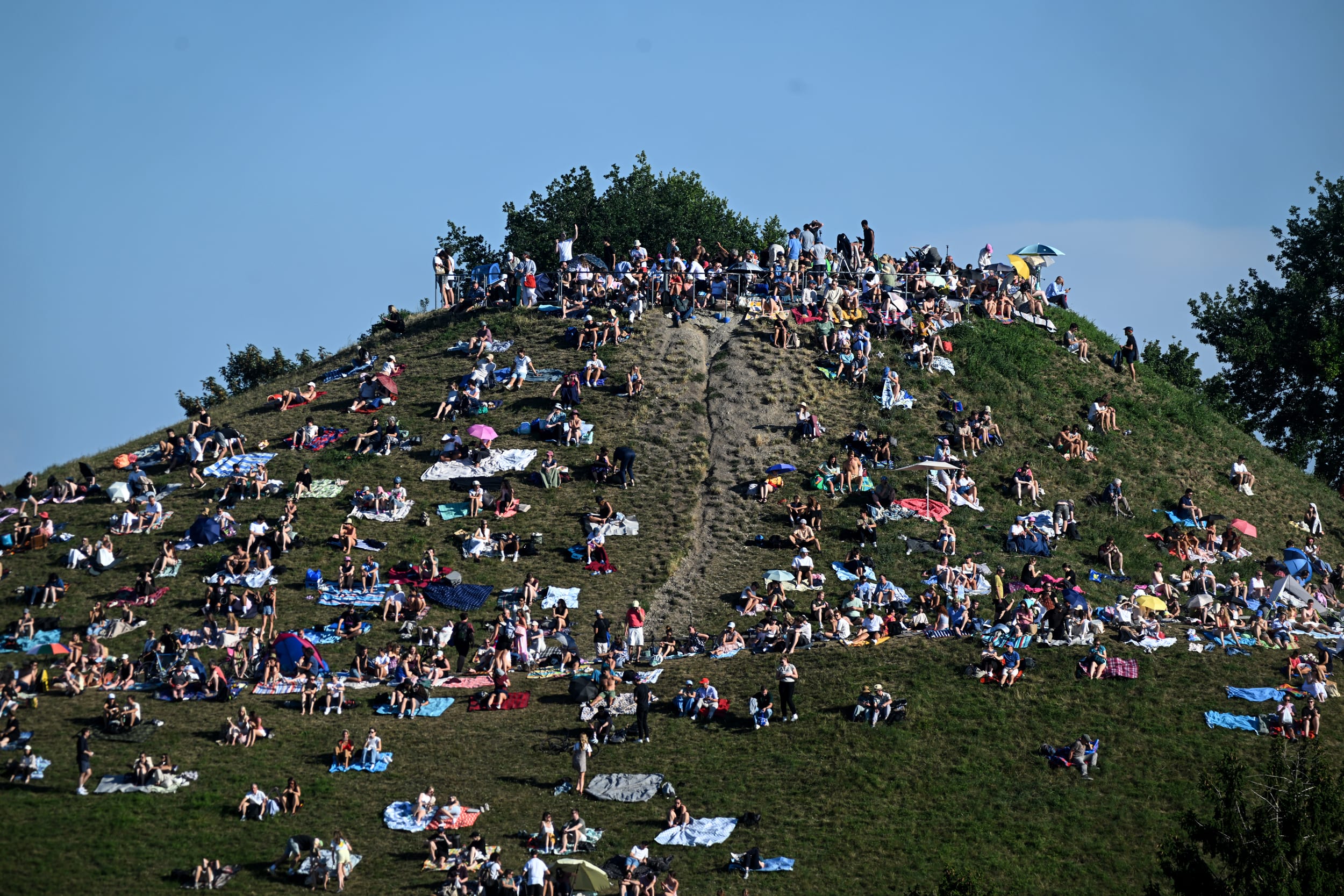
Visitors gather in Munich’s Olympiapark to watch the partial solar eclipse.<!–> t=2b–>Felix Hörhager / dpa / picture alliance via Getty Images<!–>
/qv–>

A man waits with others on Primrose Hill in the hope of catchng a partial solar eclipse in London.<!–> t=2g–>Henry Nicholls / AFP via Getty Images<!–>
/qv–>
Crowds gather in London<!–>
Lines for eclipse glasses at the National Maritime Museum in London drew thousands of people this morning.
Lucy Cooke, head of development at Royal Museums Greenwich, said the excitement surrounding today’s event is humbling and “a reminder that we are spinning on a rock.”
Acclaimed actor Celia Imrie, who came to watch the partial solar eclipse at the Royal Observatory, said this is the second eclipse she has witnessed in her lifetime.

Actor and writer Fidelis Morgan and actor Celia Imrie wait for the eclipse.<!–> t=31–>Daniele Hamamdjian / NBC News<!–>
/qv–>
“The strange silence” is what struck her most during a total eclipse she saw in 1999, Imrie said, adding that the birds were “going mad.”
“It’s a wonderful thing. I mean, nature is wonderful,” she added.
Zee Shahid, 36, who traveled to the Royal Observatory from outside Salisbury, England, said she has been thinking about the mythology ancient cultures had around solar eclipses.
“For ancient people who didn’t have any idea that an eclipse was going to happen, how absolutely terrifying that must have been to just suddenly have your sun disappear,” she said. “If you had no knowledge of what was going to happen, that must have just been a completely awe-inspiring moment.”
Alaskans were first in the U.S. to experience the partial solar eclipse<!–>
Alaska was treated to a partial solar eclipse this morning, with residents starting the day with views of the moon appearing to take a bite out of the sun.
In Anchorage, the partial eclipse began at 7:36 a.m. local time, and in Juneau, it started five minutes later.
Across the state, the portion of the sun’s light that the moon blocked ranged from 17% in Juneau to 37% in Fairbanks, according to NASA.
How to safely watch the eclipse<!–>
Viewers should never gaze directly at the sun during a solar eclipse, even when the sun is partly or mostly covered by the moon. Special eclipse glasses or pinhole projectors are required to safely view solar eclipses and prevent eye damage.
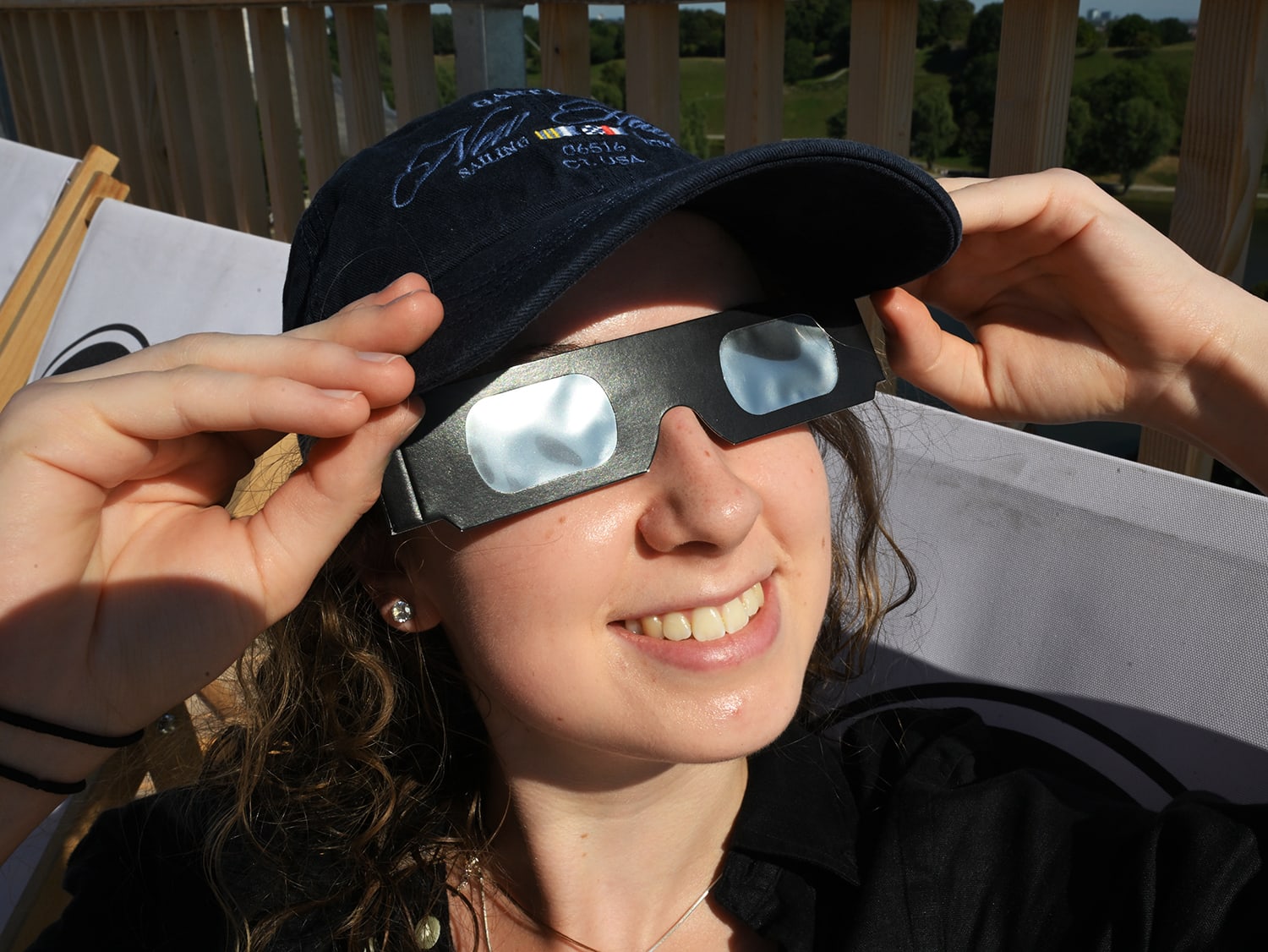
A person wears a pair of eclipse glasses ahead of the solar eclipse in Munich today.<!–> t=48–>Felix Hörhager / DPA via Getty Images<!–>
/qv–>
Skywatchers should also never view any part of the sun through binoculars, telescopes or camera lenses without specific solar filters attached to them. Eclipse glasses should not be used with them, as they won’t provide sufficient protection. Failing to take the proper precautions will result in severe eye injury, according to NASA.
During the few minutes of totality, when the moon is fully blocking the sun, it is safe to look at a total solar eclipse with the naked eye, but eclipse glasses should be used at all other times.
When does the eclipse start?<!–>
The timing of the eclipse — and how long the moon fully obscures the sun — will vary by location.
- In Reykjavík, Iceland, the moon started crossing in front of the sun at 4:47 p.m. local time, and totality will begin at 5:48 p.m. (1:48 p.m. ET).
- In Zaragoza, Spain, the partial eclipse will begin at 7:34 p.m. local time and totality will begin at 8:29 p.m. (2:29 p.m. ET).
- In Valencia, Spain, the partial eclipse will begin at 7:38 p.m. local time and totality will start at 8:32 p.m. (2:32 p.m. ET).
Most of Europe, Canada and northwestern Africa, along with parts of the northern U.S., will see a partial solar eclipse.
- In Anchorage, Alaska, the partial eclipse began at 7:36 a.m. local time (11:36 a.m. ET).
- In Portland Maine, it will begin at 12:57 p.m. ET.
- In Boston, it will start at 1:01 p.m. ET.
- In Detroit, it will begin at 1:03 p.m. ET.
- In New York City, it will start at 1:07 p.m. ET.
- And in Washington, D.C., it will begin at 1:17 p.m. ET.
Additional details on the timing for particular locations can be found on NASA’s website and at TimeandDate.com.
Another celestial event happening today: the Perseid meteor shower<!–>
Another much-anticipated skywatching event coincides with the solar eclipse. The annual Perseid meteor shower, typically one of the best of the year, has been underway since mid-July and peaks overnight from Wednesday into Thursday.
In places where the eclipse will play out around sunset, viewers might even see the meteors during totality.
Under ideal conditions — clear, dark skies, away from light pollution — the Perseids can produce as many as 100 shooting stars per hour. The meteor shower is known to produce fireballs: extra bright meteors that leave behind glowing trails as they disintegrate.
How to watch online<!–>
If you aren’t along the path of totality today (or if bad weather is thwarting your chance to see the celestial alignment), you can still catch virtual views of the total solar eclipse.
Several organizations plan to broadcast the eclipse online. NASA will host a livestream beginning at 1:15 p.m. ET, and the European Space Agency will carry a live broadcast on YouTube beginning at 1:30 p.m. ET (7:30 p.m. CEST).
What is a solar eclipse?<!–>
A solar eclipse occurs when the sun, the moon and Earth align, with the moon passing in front of the sun and blocking its light.
During a total solar eclipse, the moon fully obscures the sun’s light and skies darken as if it were dawn or dusk. Weather permitting, the sun’s outer atmosphere, which is normally obscured by the bright face of the sun, becomes visible during the moments of totality.
In a partial solar eclipse, the moon blocks only part of the sun’s light, appearing to take a bite out of it.
Another type of solar eclipse, known as an annular solar eclipse, occurs when all three celestial bodies align when the moon is at or near its farthest point from Earth. Because of this distance, the moon does not completely cover the sun. Instead, it appears as a dark disk on top of a brighter disk, an effect that leaves an orange-reddish ring around the moon.
Preparations are well underway in Villalibado, Spain, where NASA will broadcast the event to the world<!–>
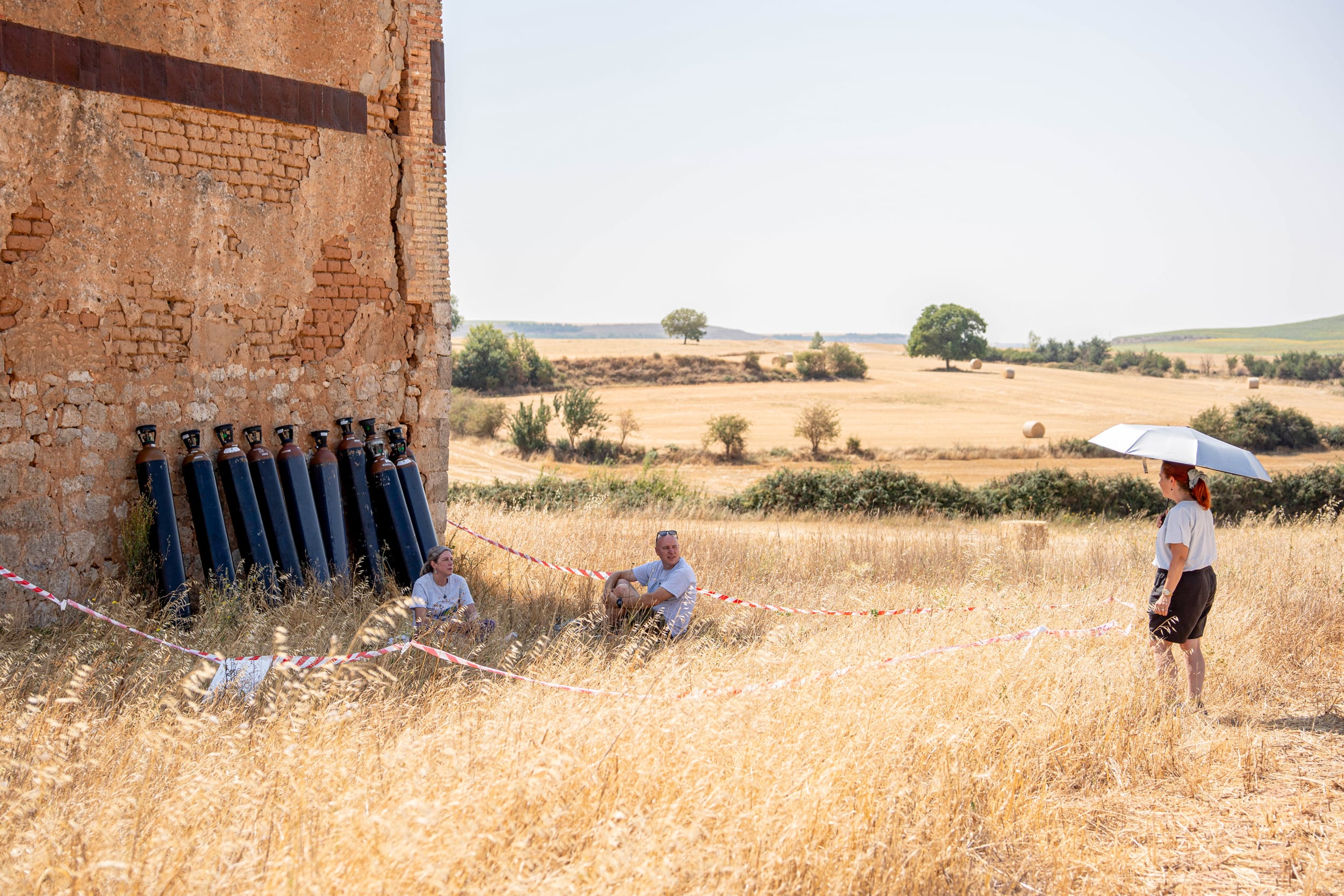
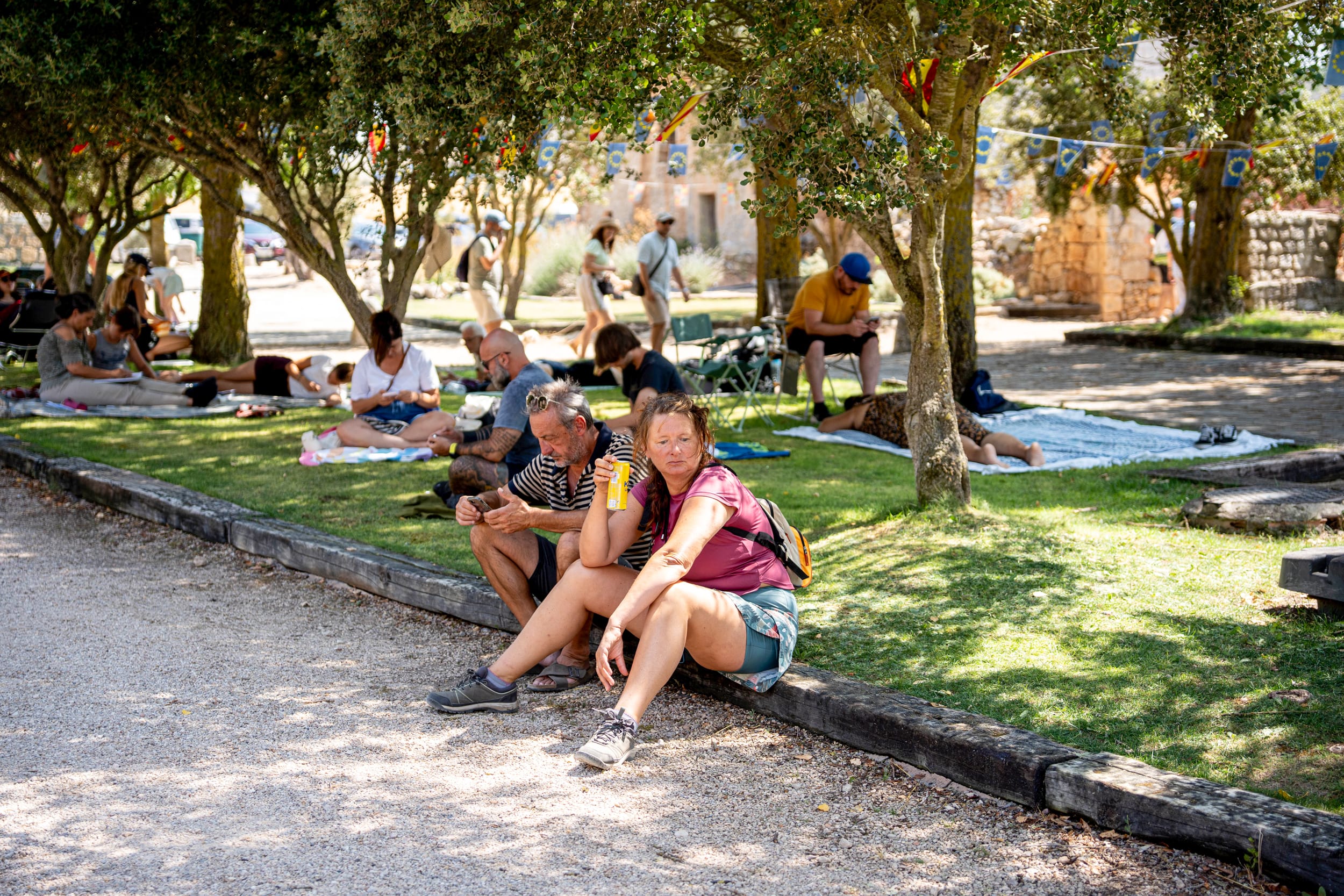
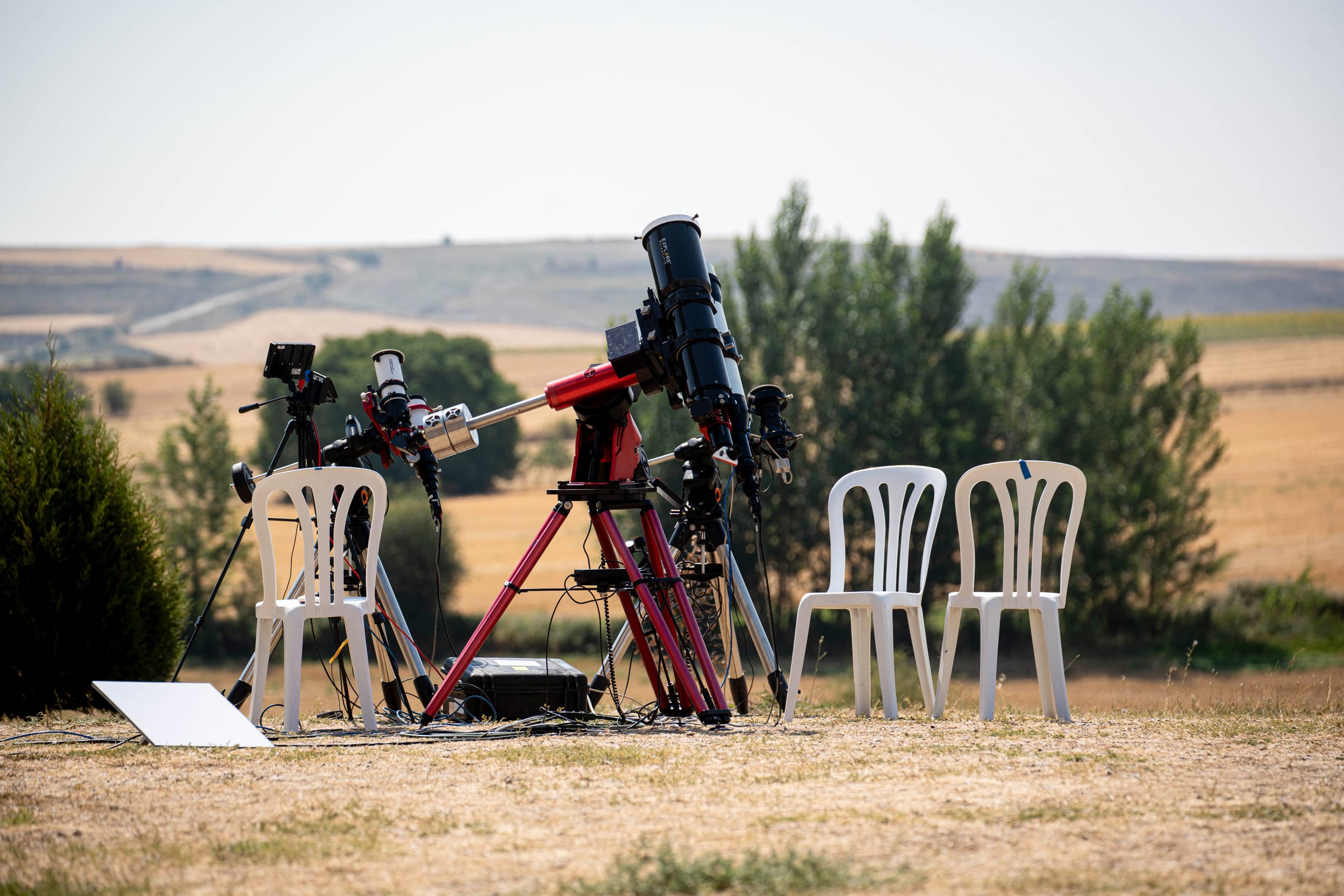
Photos from Villalibado, Spain, show NASA staff guarding helium cylinders and visitors setting up telescopes in preparation for the total solar eclipse today.
Gabriel Luengas / Europa Press via Getty Images<!–>
/qv–>
Gabriel Luengas / Europa Press via Getty Images<!–>
/qv–>
Gabriel Luengas / Europa Press via Getty Images<!–>
/qv–>
Total eclipse craze grips Europe<!–>
Around 450,000 tourists were expected to arrive in Spain this week in search of the best views of the first total solar eclipse visible from mainland Europe since 1999.
The eclipse’s path of totality — when the sun is fully blocked by the moon — will pass over Greenland first, then parts of Iceland, followed by northern Spain.
Spain will reap the most economic benefits from tourists looking to witness the “magic” moment. The country’s government estimates the revenue from eclipse-related tourism will net 347 million euros, or $400 million.
Gearing up for a total solar eclipse<!–>
One of the year’s most highly anticipated skywatching events is finally here!
A total solar eclipse is set to darken late-afternoon skies for millions of people in Spain, a small part of Portugal, Greenland, Iceland and northern Russia.
The eclipse will follow a path that cuts across the Arctic and through southern Europe. It will be the first time since 1999 that a total solar eclipse is visible from mainland Europe.
Weather permitting, most of Europe, Canada and northwestern Africa, along with people in more than 20 northern U.S. states, will see a partial solar eclipse.
Original source: https://www.nbcnews.com/sports
Author

seoexperts1994@gmail.com
Related Posts

Former NFL QB Matt Hasselbeck part of latest CTE frontier — diagnosing brain disease in the living
- 0
- 1,439 word
Former NFL QB Matt Hasselbeck part of latest CTE frontier — diagnosing brain disease in the livingThe three-time Pro Bowl selection recently...
Read out all
Surging Red Sox are ‘right there’ in wide-open AL
- 0
- 526 words
Watch Now Surging Red Sox are 'right there' in wide-open AL August 12, 2026 11:00 AM CC Sabathia looks at how the...
Read out all
Phillies’ Luzardo has blossomed into a ‘legit ace’
- 0
- 520 words
Watch Now Phillies' Luzardo has blossomed into a ‘legit ace’ August 12, 2026 11:00 AM CC Sabathia and Ahmed Fareed highlight how...
Read out all
Cubs on Brewers’ tail behind elite defensive play
- 0
- 514 words
Watch Now Cubs on Brewers' tail behind elite defensive play August 12, 2026 11:00 AM CC Sabathia and Ahmed Fareed examine how...
Read out all
Harris II has ‘figured out how he can be great’
- 0
- 515 words
Watch Now Harris II has 'figured out how he can be great’ August 12, 2026 11:00 AM Michael Harris II has flourished...
Read out all
Los Angeles Lakers sold to Bob Iger, Josh Kushner for $12 billion
- 0
- 324 words
BREAKING NEWSUpdated 16 minutes agoNBALos Angeles Lakers sold to Bob Iger, Josh Kushner for $12 billionThe Lakers were previously sold to businessman...
Read out all