
- 0
- 1,747 word
Violent crime plummeted in 2025, with murder rate hitting 20-year low, FBI says

Violent crime rates in the U.S. have plummeted, with the nation’s murder rate reaching a 20-year low in 2025 and violent crime overall showing the biggest one-year drop on record, according to data released Friday from the FBI’s annual crime report.
The FBI’s report, which compiles crime data from about 87% of the country’s police departments, shows an 18.1% decrease in the murder rate compared with the prior year.
Violent crime rates in multiple categories also saw significant year-over-year decreases across the country, with aggravated assaults falling by 7.2%, rapes declining by 7.6% and robbery down 18.5%, according to the FBI’s report.
Speaking at the Nassau County Police Academy on Long Island Friday afternoon, President Trump touted the positive numbers.
“Today I’m thrilled to announce that the FBI has just released the new Uniform Crime Report showing that in 2025, we achieved the single largest reduction in violent crime in American history,” the president said.
“This FBI has led the charge to arrest eight of the top 10 most wanted fugitives on planet Earth in the last 16 months,” FBI Director Kash Patel said at the police academy event.
The report also found that reported hate crime incidents decreased about 7%. The data released Friday did not break down which groups were targeted in those hate crimes.
In other categories, motor vehicle theft decreased by 22.7% in 2025 and burglary decreased by 15.8%, it said.
The data reflects a trend experts have been tracking for several years as reported numbers of violent crimes continue to drop from a spike immediately following the COVID-19 pandemic.
“This release confirms that crime in the U.S. is falling at or near a historic clip,” said Jeff Asher, co-founder of the data analytics firm AH Datalytics. “This is the third straight year of a record drop in murder and the data for 2026 points to a continued large drop this year.”
One category that saw an increase was reported assaults on law enforcement officers, which include aggravated and simple assault offenses. Reports of such crimes reached a 10-year high, with 90,178 officers assaulted in the line of duty. It was not clear, however, whether that increase has any correlation to the Trump administration’s stepped-up immigration and violent crime crackdowns.
Since taking office in January 2025, the Trump administration has pursued a hard-line approach to public safety. These efforts included major immigration crackdowns in cities across the country, notably resulting in the highly publicized shooting deaths of U.S. citizens Renee Good and Alex Pretti in Minneapolis. The administration has also overseen the deployment of National Guard troops to several big cities. In Washington, D.C., the National Guard was sent to assist local police with high levels of vehicle theft and gun violence, a move that remains a point of intense public debate.
AP Photo/Julia Demaree Nikhinson 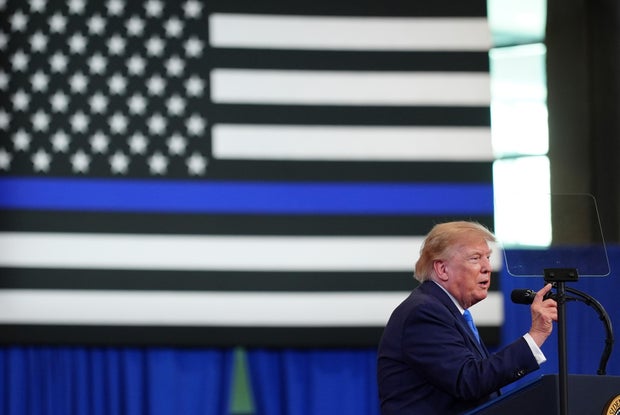
Despite the administration’s focus on federal action, many criminal justice experts argue that the downward trend results from several complex factors rather than a single policy.
“The homicide drop is historic and crystal clear. But right now, what’s driving it is about as clear as a glass of milk,” said Adam Gelb, CEO of the Council on Criminal Justice, a nonpartisan think tank that releases early analysis of police department data each year.
“Rates are falling in cities with very different public safety strategies, economic conditions, and political leadership. The consistency across the map should make us cautious about handing credit to any one leader, party, policy, or program before the evidence catches up.”
Gelb noted that societal shifts, such as technology keeping more people at home and a decrease in alcohol abuse, may play a role in the historic homicide drop. He also said that after a surge in drug overdose deaths and murders during the pandemic, as well as the detention and deportation of people with criminal histories and charges, there are tens of thousands fewer “high-risk” individuals on the streets than five years ago, which may contribute to the lower homicide numbers.
Thaddeus Johnson, an assistant professor of criminology at Georgia State University and a former police official in Memphis, cautioned against oversimplification. Having studied the crime drops in both Memphis and D.C., Johnson argues that smarter information-sharing among police and shifts in public behavior are as critical as any specific policy.
“During the pandemic, police got smarter and started sharing more data,” Johnson said. He noted that violence reduction programs have helped, and research showed that the overdose epidemic limited the “supply” of high-risk offenders and victims.
He cautioned that it is still too early to know if these drops will continue or if the downward trend is a momentary blip. Johnson said learning about and focusing on what works will be key to keeping the momentum.
“We need to double down on community violence intervention and bolster the neighborhoods disproportionately affected by crime,” Johnson said.
“We need to think not only about 10 days but also 10 years from now.”
Good old-fashioned policing combined with technology
The Uniform Crime Report compiles statistics from law enforcement agencies around the country that participate in the FBI’s data collection, covering about 96% of the U.S. population. The latest data continued 2024’s decreases in every major category.
In Buffalo, New York, the trend in recent years has been particularly promising: the homicide rate fell 48% between 2019 and 2025, analysis from the Council on Criminal Justice found. According to Timothy Richards, senior special assistant to the Buffalo police commissioner, that momentum has carried into 2026, with year-to-date homicides down 33% from the previous year.
Homicide detective Mark Costantino, a 27-year veteran of the Buffalo Police, attributes the success to “outstanding teamwork” and the integration of new investigative technologies, such as cellphone triangulation and video surveillance. He also said the change comes from a shift in the community itself over the past five or six years.
“I’ve seen a real change. There is a huge uptick of people just not willing to put up with it anymore,” Costantino said, referring to the gang violence that once plagued parts of the city. Buffalo police have leaned into this shift by establishing an extensive community policing unit.
“We work really hard on communicating the right way,” said Costantino, acknowledging that there are many people who don’t feel like they trust or like the police. “We work really hard at trying to break that down a little bit.”
These tidbits of information from the community can help police arrest violent offenders. Detectives then work with technology such as cellphone tower triangulation and video surveillance to solve cases.
Costantino said even with the drop in murders, the homicide unit is always busy, but the reduction has freed him up to tackle something he’s been wanting to work on for years: cold cases.
The Denver Police Department credited a range of steps with contributing to that city’s drop in homicides last year. Denver saw homicide cases decline 48% in 2025 compared to 2024.
In a statement Friday, Denver Police said those measures have included “focused, holistic efforts in identified high crime areas, removing firearms from the streets, the utilization of technology, focused policing, and top-notch investigations.”
Federal policies can clash with local priorities
While cities like Buffalo focus on community ties, the Trump administration has highlighted its more muscular federal approach in Washington, D.C. The capital has been the center of a federal crackdown involving the deployment of federal agents and National Guard troops to patrol local streets.
Mr. Trump boasted Friday, “We’ve taken it from the worst to one of the most dangerous, if you can imagine, our nation’s capital, one of the most dangerous cities in the country — we’ve taken it to one of the safest cities of the country, in the world.”
In a fiery letter to the D.C. Council released this week by the Justice Department, senior DOJ official Colin McDonald credited the National Guard for helping lower the city’s crime rate, after the council sent a letter in July to governors urging the withdrawal of National Guard troops from D.C.
McDonald also highlighted a July 28 report from D.C.’s inspector general, which found that the Metropolitan Police Department’s crime data reporting process experienced a “prolonged, systemic breakdown” and was susceptible to classification errors going undetected.
Jeanine Pirro, the U.S. Attorney for the District of Columbia, has had to assign additional resources to address the uptick in arrests that have resulted from the surge.
Earlier this week, her office said that it has charged 16,724 cases in D.C. Superior Court since last August — a 67% increase from the prior year.
Year over year, her office said homicides dropped by 45%, carjackings fell by 64% and motor vehicle thefts fell by 53%.
At the same time, however, her office has also been met with challenges — particularly in the first few months of the surge — as federal grand juries in some cases refused to return indictments and prosecutors were forced to drop cases. One magistrate judge calculated that the department had dropped 21% of its cases over an eight-week period, compared with a 0.5% dismissal rate over the prior 10 years.
One of the most high-profile losses entailed the Nov. 2025 acquittal of Sean Dunn, who was prosecuted for misdemeanor assault for hurling a Subway-style sandwich at a U.S. Customs and Border Protection officer. A grand jury had previously declined to charge him with felony assault.
Original source: https://www.cbsnews.com/world/
Author

seoexperts1994@gmail.com