
- 0
- 1,719 word
‘Where’s the humanity?’ Why job seekers say hiring is ‘broken’
 Rachel Barber
After getting a layoff notice in May, engineer Todd Hendricks, 46, started his job search. One Friday, he signed on to Zoom for the coding round of a multistep interview process and waited for someone to appear. No one did.
He reached out to the recruiter and heard nothing back. The next Monday, an email landed in his inbox. The company said it was no longer moving forward with his application, based on his performance in the interview he says never happened.
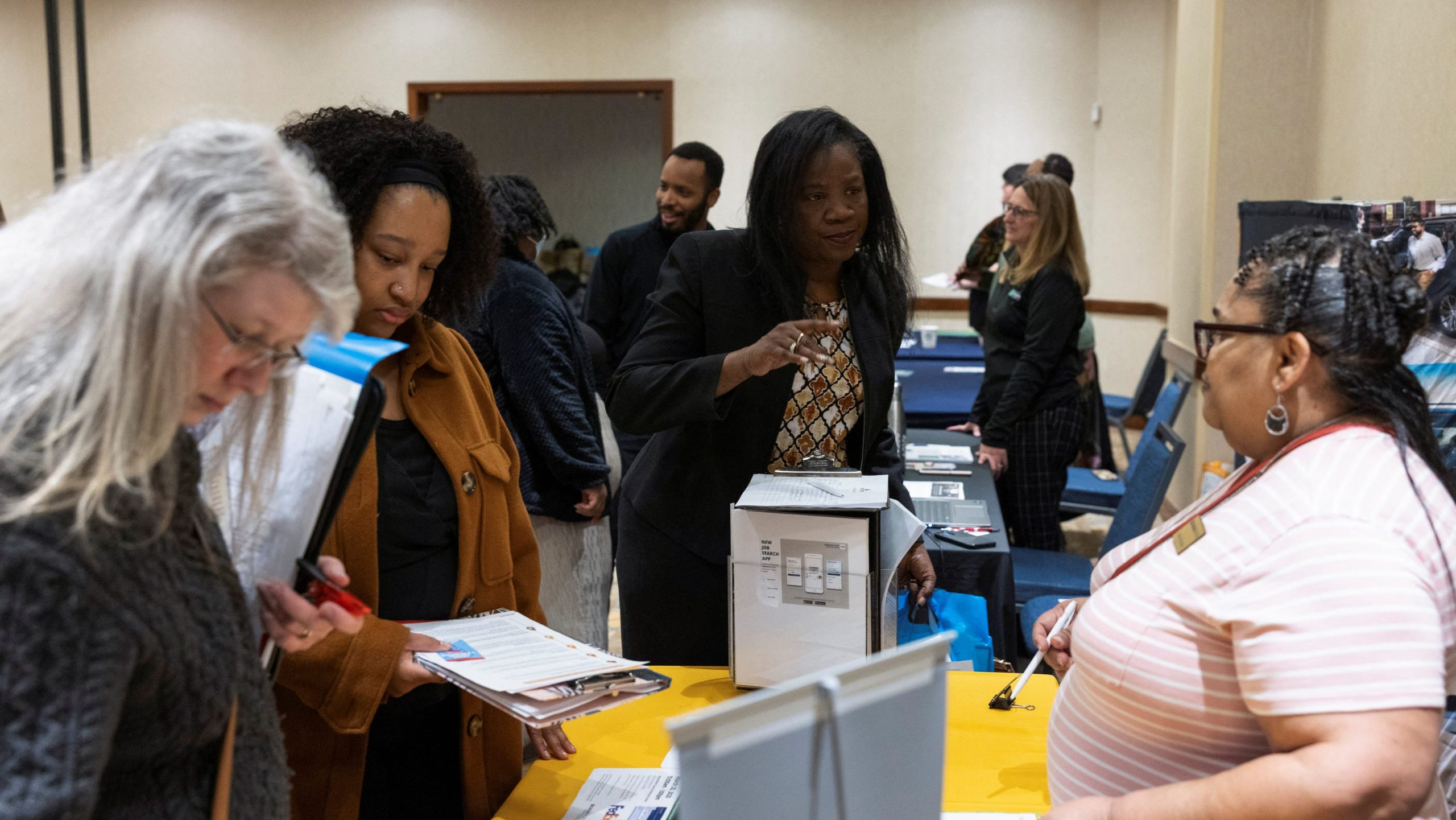
Hendricks is one of many American job seekers who believe the hiring process is “broken.” Finding a job has rarely been easy, but in 2026, fierce competition, the growing use of artificial intelligence and a lack of trust in employers have further complicated the process.
U.S. employers added a historically low number of jobs in 2025. Hiring bounced back in the spring but has cooled in recent months. Employers shed 23,000 roles in July. People are still getting hired, though much of the recent job growth has been concentrated in a few select sectors, like health care. The search is tougher for candidates like Hendricks, who is looking for a job in technology – an industry that accounts for 31% of all job cuts announced this year, according to a Challenger, Gray & Christmas report.
The nation’s unemployment rate was relatively low at 4.1% in July, though economists say it fell this year largely because workers dropped out of the labor force, not because a massive number of candidates were hired. Some analysts believe one reason behind the departures is burnout from the job search.

‘Volume has replaced intention’
After being laid off in May 2023, Candee Petersen said she secured a new job three months later in August, only to be laid off again in September. Though she has landed some contract work since, Petersen, 54, said that about 5,000 applications later, she’s still without a full-time job. A former executive administrative business partner, she first applied to similar roles. As time dragged on, she applied to “everything” that aligned with her skill set.
Amanda Dobson, founder of Clear Pathways, an HR and leadership advisory firm, said one of the problems with hiring today may be that “volume has replaced intention” for job seekers and recruiters alike.
The explosion of remote work amid the COVID-19 pandemic led to more applicants vying for the same jobs around the country rather than competing with just those in their area or those willing to relocate for a position, Dobson said.
U.S. applicants per open role have doubled since spring 2022, according to LinkedIn research released at the start of this year. It found that 65% of people said finding a job had become more challenging, citing competition as the main obstacle.
Recruiters used to review about 100 applications per role in early 2021. They are now processing 291 per hire, according to a 2026 Talent Trends report by Ashby, a recruiting platform.
Employers receive hundreds of applications and cannot respond to each. Applicants don’t hear back, so they apply for more jobs, and the cycle continues, Dobson said.
Vicki Salemi, a career expert at job listings site Monster, said she has seen lifeguards apply to certified public accountant roles and a candidate apply to 10 positions at the same company at one time, a “red flag” to the employer. She and Dobson advise job seekers to narrow their search.
If you’re “sending out 500 applications as a candidate, there’s no way that you actually want to work for those 500 jobs,” Dobson said. “Instead of spending the energy – the five to 10 minutes per application that you’re sending out – and sending it out 500 times, take 20 minutes on your resume and take 20 minutes on your application to thoughtfully answer the application questions.”
‘Where’s the humanity’ in the AI age?
A problem with that approach may be that only 10% of job seekers feel that most of their applications are reviewed by a human, according to LiveCareer’s 2025 Job Search Frustration Survey, though 64% believed their resumes were optimized for applicant tracking systems.
Dobson said they’re right to be skeptical.
“I talk with a lot of HR professionals, and in the recruitment process, they’re not looking at every single resume,” she said. “They’re letting the systems do that.”
At 93%, most recruiters surveyed by LinkedIn late last year said they planned to increase their AI use in 2026, and 59% said the technology was already helping them discover new candidates. Some have gone so far as to introduce AI interviewers.
“Nobody talks to you anymore. You get invitations, ‘Oh, we have an AI interview.’ I’m not talking to AI. I’m not sending a Loom video just so you can see me sitting there talking to myself,” Petersen said. “Where’s the humanity in this?”
But applicants are using AI, too. The LinkedIn survey found 81% of people had used AI to assist their job search or said they planned to. Hendricks described it as an “automation arms race.”
“Applicants are increasingly using AI to tailor their resumes and cover letters on the applications, and employers increasingly will use AI or other automated systems to filter and rank those applications,” he said.
Hendricks is not relying on AI to rewrite his applications, however.
“Even before AI, there was this concept that you should have a unique resume for every job application,” he said. “Now, AI has made that easier, whereas people used to do it by hand. But I mean, my experience is my experience. I’m not going to augment it in ways that aren’t true.”
Even if an applicant uses AI to help optimize their application, if a tracking system is flagging resumes for specific keywords or phrases, a misplaced comma may be the reason an applicant is never seriously considered, Dobson said.
“Because of where a comma was placed in their criteria, they were auto-rejecting a lot of candidates that they should have been reviewing,” she said of one company. “We’re relying too heavily on these systems and not using a human to review candidates.”
‘Ghost jobs’ and a lack of trust
The usual way people measure job market tightness is by comparing the number of open jobs with the number of unemployed people.
However, “a large and rising share of job postings target already-employed workers or represent inactive listings,” a Federal Reserve Bank of St. Louis analysis said last November. “As a result, the vacancy-to-unemployment ratio now overstates how tight the labor market truly is for unemployed workers.”
Even if a job listing is not a scam, a company may post a role while planning to hire internally or recruiting someone already employed elsewhere. A budget change could mean a role that was once real is now cut. In those cases, a company may advertise an opening that job seekers never had a realistic chance of getting. Candidates call these listings “ghost jobs.”
Another Ashby report released last year analyzing data from its customer base found that 82% of open jobs in 2024 led to a real hire but that 5.5% were paused, 1% led to an offer but no hire, and 3.5% were pulled without a reason given.
Applicants “have no way to know whether another candidate was selected, or the hiring plan changed, or the position was never actively being filled, and it was just a listing to increase the appearance of success on the part of the company,” Hendricks said. “If I apply to 10 positions and receive no interviews, I need to know whether that means I’m targeting the wrong roles, or I’m presenting my experience poorly, or I’m applying to positions that weren’t realistic opportunities in the first place.”
Salemi said that while it’s true there are job postings unemployed candidates never had a realistic chance of getting, companies “don’t post them just for fun” but rather to build a talent pipeline or stack of resumes to reference the next time they have an opening.
Talent pipelines haven’t worked out for Petersen.
“Nobody ever has called me back because they built a pipeline from a job that I applied to three years ago,” Petersen said.
Doubting job descriptions and scanning for scams
Candidates have more trust in job postings when companies share clear salary ranges as well as transparent expectations around workload and hours, a new Monster report found. But they don’t always get them.
After reviewing enough job posts that listed the position as remote only to find out the company requires employees to work in office, Petersen doesn’t trust job descriptions anymore.
She’s not alone. Only 10% of workers say job descriptions “always” accurately reflect the reality of the role, according to the Monster report. It found that 81% of workers surveyed said they at least sometimes encounter job descriptions that “feel vague or overly polished.”
Beyond determining whether a company means what it says in a job posting, candidates also are navigating scam offers. Petersen said she receives suspicious texts and emails promising to help her land a job “every day.”
“You get, ‘Of course. Yeah. We have a job for you, but you need to pay this person to rewrite your resume,’” she said. “It’s scary to see how many people will try to take advantage of somebody who’s already down.”
At 95%, most job seekers have encountered a suspicious job offer, and 98% said today’s job market increases vulnerability to scams, a separate Monster report found.
To verify whether an opportunity is real, Salemi said, job seekers should ask themselves a few questions: Is it realistic? Does it highlight specific responsibilities? Is it listed on the company website? Does the company have a mailing address? Does the recruiter have a professional email address?
She reminds job seekers that most companies won’t need their Social Security number or address until after they are onboarded.
“Legitimate employers will not just immediately hire you without having screened you,” Salemi said. “Your gut was likely going to be right anyway. So trust it.”
Reach Rachel Barber at rbarber@usatoday.com, follow her on X @rachelbarber_, and subscribe to her newsletter “Making More of Your Money” here
Original source: https://www.usatoday.com/money/
Author

seoexperts1994@gmail.com
Related Posts

Always exhausted? Here’s how to tell if it’s burnout
- 0
- 892 words
HEALTH AND WELLNESSMental HealthAlways exhausted? Here's how to tell if it's burnout Daryl AustinUSA TODAYAug. 21, 2026, 5:00 a.m. ETFeeling mentally drained...
Read out all
Is the US government’s spending problem killing your American dream?
- 0
- 876 words
PERSONAL FINANCEDonald TrumpIs the US government's spending problem killing your American dream? Medora LeeUSA TODAYAug. 21, 2026, 4:54 a.m. ETThe U.S. government's...
Read out all8 dead after charter plane crash in western Alaska, military says
- 0
- 349 words
NATIONAirplane Accidents and Disasters8 dead after charter plane crash in western Alaska, military says Charles VenturaUSA TODAYUpdated Aug. 21, 2026, 3:07 a.m....
Read out allAmericans who say they drink alcohol remains at record low, survey finds
- 0
- 370 words
HEALTH AND WELLNESSAlcoholic BeveragesAmericans who say they drink alcohol remains at record low, survey finds Sara MoniuszkoUSA TODAYUpdated Aug. 20, 2026, 2:46...
Read out allThese are the best states to live in, according to new ranking
- 0
- 320 words
MONEYWalletHubThese are the best states to live in, according to new ranking Gabe HauariUSA TODAYUpdated Aug. 20, 2026, 5:03 p.m. ETHow good...
Read out all
Are you an UNO champion? You could earn $50K in this new tournament
- 0
- 455 words
MONEYMattelAre you an UNO champion? You could earn $50K in this new tournament Greta CrossUSA TODAYAug. 20, 2026, 4:29 p.m. ETDid family...
Read out all